1. Real Situation (2000)
Duisburg, February 2000: The Plan That Could Have Changed Everything
In an unassuming office in ElekTronikPark Duisburg lay a document that was supposed to change Europe forever: the business plan of Shopping City AG, written by Mike Meyer for Mannesmann Pilotentwicklung. Over 27 pages, it outlined nothing less than the blueprint for a sovereign, democratic internet made in Europe. The core elements were the Citythek—a semantic search engine that would have made Google look old—and the Shopping-Card, a PKI-based payment system that would have made PayPal obsolete. But the truly revolutionary part was in the fine print: The technology for it came from my company, getTIME.net GmbH. My Finder technology (Patent ES2374881T3) would have given Citythek what Google still cannot achieve today: precise, hallucination-free search, based on 1,000 clearly defined categories—a system controlled by users, not manipulated by algorithms.
Partly due to synergies, 100,000 hours of work had already been invested in development, without external capital, driven by a vision: A Europe that controls its own data. GraTeach was not just a training academy but the technological lever to turn Mannesmann’s e-commerce dreams into reality. The synergies were perfect:
- getTIME.net provided the search engine logic, GraTeach the executives and the web interface with social media architecture,
- Mannesmann brought the infrastructure (partnerships with Deutsche Bank, Hermes, Astra-Net),
- Shopping City AG was to be the commercial arm—a European Amazon, but fair, transparent, and user-controlled.
Then came Prof. Landscheid.
The Blockade: „Not Economically Viable“
Dr. Landscheid, then as now influential in the Regional Conference Kamp-Lintfort, knew about my Mannesmann rescue plan. On January 9, 2000, I had a conversation with Mayor Landscheidt about whether he would be willing to push an idea up to Chancellor Gerhard Schröder. This went far beyond Shopping City AG: It included a complete ecosystem of social media, secure payment solutions, and a digital trading platform that could stand up to US corporations. Instead of support, however, I encountered silence—or worse: targeted sabotage.
When GraTeach slipped into insolvency in 2001, the official reason was a lease agreement from which they could not be released, even though this had been promised in the Regional Conference. But the real reason ran deeper: Political and economic blockades orchestrated by actors who had an interest in keeping Europe dependent. The NRW State Chancellery did not hesitate to describe GraTeach as „not economically viable.“ A farce. While other startups were funded with millions—often without comparable substance—this project was deliberately bled dry.
„How can a concept that was supposed to save Mannesmann, create thousands of jobs, and make Europe digitally sovereign be ’not viable‘?“
The answer lies in the systematic nature of the decisions at the time:
- Banks feared competition from the Shopping-Card (which would have made their own payment solutions obsolete).
- US tech giants like Amazon and Google had no interest in a European counter-model.
- Political decision-makers—perhaps even in collusion with the NRW judiciary (which later pursued me criminally for eleven years without cause)—ensured that GraTeach had no room to breathe.
„Stones were placed in my path where others rolled out red carpets.“
„This was not coincidence. This was system.“
The Sale to Vodafone: Could It Have Been Avoided If GISAD Had Existed?
This is where it gets explosive. A democracy-preserving metric for societal structural relevance in digital projects is not desired. But what if?
-
GISAD as a Democratic Clearinghouse
If GISAD had existed in 2000, it would have been the natural partner for Mannesmann—not just technologically, but also strategically. GISAD would have:- Developed evaluation models showing that Mannesmann’s rescue plan was sustainably more profitable than Vodafone’s takeover offer.
- Built public pressure to stop the Vodafone takeover—with the argument: „Why give away a European tech giant to a British corporation when we have a better solution ourselves?“
- Positioned the Finder technology as a USP: „Mannesmann with the GraTeach overall concept = a European Google + Amazon + PayPal in one.“
-
The Metrics Lie
Vodafone’s takeover of Mannesmann (for 190 billion euros) was presented as „unbeatable“ in 2000. But what if GISAD had proven that the rescue plan created more long-term value for Europe?- Shopping City AG would have generated billions in revenue—in Europe, not in the USA.
- Citythek would have become the standard for e-commerce search, with data sovereignty in Germany.
- The Shopping-Card would have made PayPal obsolete—and secured Europe’s control over payment data.
„With a comprehensive concept behind us, Mannesmann wouldn’t have needed to be sold at all.“
„We could have outbid Vodafone—not with empty promises, but with hard facts: sustainably more jobs, more tax revenue, more sovereignty.“
Instead, Mannesmann was dismantled. The pilot development (and thus Shopping City AG) was discontinued. I was financially and mentally weakened to the point that I could no longer maintain the patent. And Europe lost its last chance to play a leading role in the digital age.
2. Development Without Obstruction (2000)
If the Finder technology had prevailed, Europe would be digitally sovereign today. The 1,000 categories would not only have revolutionized search engines but also laid the foundation for a European Digital Union (EU-D-S). Instead of data colonialism, there would be an infrastructure that empowers users and distributes value creation fairly. getmysense would long have been a global model for inclusive, privacy-friendly networks.
With GISAD as a democratic clearinghouse, Europe would have built a real alternative to US corporations. The 190 billion euros from the Mannesmann takeover would have flowed into European infrastructure, research, and jobs—instead of being drained abroad.
3. View from the Future (2026)
Even today, only 3 billion euros would be needed to give 100 million EU citizens access to the EU-D-S!
2026 shows: The Finder logic would have been unbeatable. With the EU-D-S initiative, Europe would finally have become a digital power—not through complexity, but through clear structures. The 1,000 categories would now be standard in public search systems. Google and Amazon? They would be struggling with regulation, while Europe retains value creation.
The three fatal mistakes of the digital economy for a functioning society:
-
Complexity Instead of Simplicity:
The Semantic Web failed due to its own overload. My 1,000 categories would have been the solution. -
Gatekeepers Instead of User Control:
Google, Facebook & Co. built their empires on distraction and data exploitation. My model would have shown: It can be done without advertising labyrinths. -
No Transfer of Human Structures:
Today, even modern systems struggle with hallucinations—because there is no systematic integration of human evaluation. My 1999 approach was already ahead.
The Consequences:
- Google & Co. dominate: Not because they are better, but because they trap users in their systems.
- Europe remains dependent: Instead of promoting Finder, it imported US technologies—and citizens lost control over data and values.
- The irony: Today, corporations seem desperately searching for solutions for „trustworthy AI“—yet I already had them in 1999.
What remains? A question that still stands today: Why did Europe bet on complexity when there was a simple, better solution?
4. The GAP 2000
| Long-term Value Creation in Europe (Shopping City AG, Citythek) | Short-term Profits for Hedge Funds/Banks; Discontinuation of Pilot Development |
Analysis 2000: (created without guarantee by AI)
-
Macroeconomic Impact of the Vodafone Takeover (190 Billion Euros):
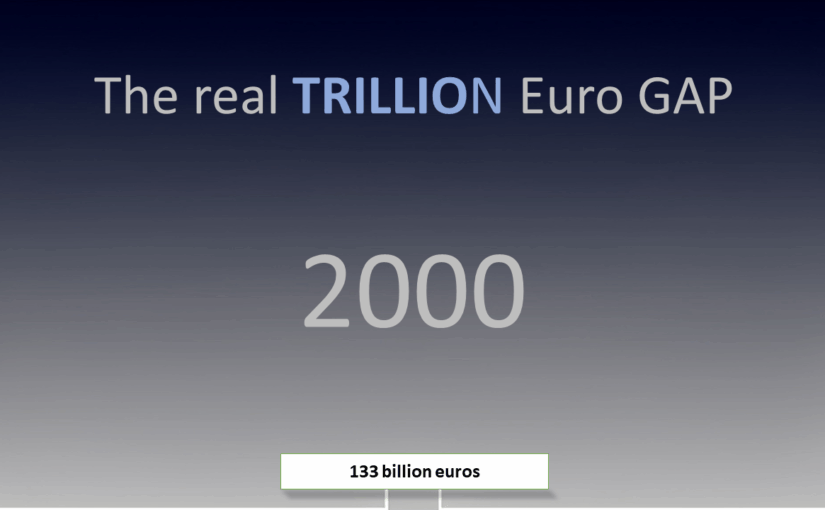
At least 70% (133 billion euros) of the takeover sum did not flow into European digital infrastructure, but to international investors—without any commitment to reinvest in Europe (https://blog.ipleaders.in/largest-merger-history-vodafone-mannesmann/), (https://www.sciencedirect.com/science/article/pii/S105752190300005X).- Vodafone used the 190 billion euros for global expansion (USA/Asia)—not for European infrastructure (https://www.goldmansachs.com/our-firm/history/moments/2000-vodafone-mannesmann-merger).
- Mannesmann’s e-commerce plans (Citythek, Shopping-Card) were discontinued—the 100,000 hours of preliminary work for a European Amazon/Google were lost.
- Tax Optimization: Vodafone channeled profits through Dutch letterbox companies—a pattern later also used by Google/Amazon (https://www.aboutamazon.eu/news/job-creation-and-investment/amazons-corporate-tax-contributions-in-europe).
-
Lack of Investment in European Alternatives:
The Finder technology and GISAD could have served as the basis for a democratic digital economy. Instead, no funds were invested in European projects—the dependence on US corporations (Google, Amazon, PayPal) increased. -
GraTeach Insolvency: (see 2021)
The loss of technological know-how and 10 years of preliminary work, which could have been used to develop a European search engine and payment solution, was a severe setback.
Transfer of the GAP from 1999:
In 1999, the GAP was still zero, as Google and Amazon generated hardly any revenue in Europe. In 2000, the GAP began to grow because the course was set for dependence:
- 133 billion euros (70% of 190 billion) did not flow into European infrastructure.
- The GraTeach insolvency prevented the development of a European alternative to Google/Amazon.
- No investments in democracy-preserving structures led to long-term dependence on US platforms.
Consequences for the Future:
- Europe lost control over its digital future.
- The 133 billion euros could have preserved structures—instead, they flowed abroad.
- The GAP will continue to grow in the coming years as dependence on US corporations increases and European alternatives are lacking.