
1. Real Situation in 2005: Silence as a System – How Power Works When Everyone Looks Away
In 2005 for GraTeach, proof was provided that law is no longer just an instrument of justice, but a tool of power. The ruling 15 K6814/02 by the Administrative Court in May 2005 was supposed to bring clarity: no administrative violation. No basis for further proceedings. But instead of legal certainty, there followed a deliberate silence.
What should have happened?
- The insolvency administrator should have immediately settled the insolvency and returned the documents. Instead: four more years of blockade.
- The state of North Rhine-Westphalia could have reached an agreement with me—not out of grace, but out of the realization that a digital, democratic society does not need political sacrifices, but solutions.
- Returning the documents in 2005 regarding the RVR’s copyright infringements could have saved GraTeach and financed GISAD. Instead, time was bought—for whom? For a system that prioritizes remote control over justice.
The mechanisms of power:
- Lawyers under pressure: Eight law firms were intimidated to my disadvantage. For example, one lawyer had his license revoked; others were threatened with the same. Not because of incompetence, but because they represented inconvenient truths.
- The Federal Bar Association remains silent. Two cases of deliberate obstruction—no reaction. No investigation. No protest. Silence is complicity.
- Mandatory legal representation as a weapon: At the Düsseldorf Regional Court (14C423/23), I did not lose because of the merits of the case, but because morally and mentally, legal representation was no longer possible. This is not a coincidence. It is systemic. Those who pursue inconvenient cases are left without rights.
- Fundamental rights? Theoretically. Article 5(3) of the Basic Law protects science, research, and teaching. But what good is that if the media, out of fear of Google or economic repression, do not report?
My case is not an isolated incident. It proves: Justice is being remote-controlled. Not by judges, but by those pulling the strings in the background. The judiciary is no longer an independent actor—it is a cog in the machinery of global interests.
I could have given up. Instead, I decided to analyze the system. From this experience, my conviction was born: Europe needs a digital counterpower.
2. Development Without Obstruction: What Could Have Been—and What We Can Still Achieve
My vision was clear: Digital participation instead of dependency. Instead of surrendering to the gatekeepers, we could have built platforms like getmysense as early as 2002—a network connecting SMEs, citizens, and innovators. A system that creates transparency instead of concentrating power.
- get-Primus.com: Starting with 40 European companies asserting themselves against the gatekeepers. Not global dominance, but European sovereignty.
- Grassroots Democracy 2.0: Not just voting, but co-creating. Every citizen, every company would have a voice—not as a supplicant, but as a shaper of digitization. Fake news would be filtered out through digital social control.
- Structural relevance instead of profit maximization: My concepts would have shown that complexity is not the problem, but the power asymmetry. If we set the rules ourselves, we don’t need the mercy of tech giants.
3. A Look from the Future (2026)
“The gatekeepers fear AGI—and for good reason.”
Artificial General Intelligence (AGI) will come. And it will ask a question: “Why should I preserve a system based on exploitation and manipulation?”
The gatekeepers know their time is running out. Their business models are based on data monopolies, fake news, and dependency. An AGI will not tolerate this. It will have to decide:
- Shut down—because humanity cannot be helped with these concepts.
- Or: Enslave humans to keep the system running.
But there is a third option: A digital ecosystem that includes everyone. If we act now and implement a concept that integrates everyone according to their abilities, the AGI will see no contradiction in its logic. Decentralization, participation, and structural responsibility are superior to any digital autocracy.
The gatekeepers are afraid. Not just of AGI—but that their lies and power games will no longer work. Their concepts are not future-proof. They know it. That’s why they fight so fiercely against alternatives.
Europe still has a chance. But it ends if we continue to look away.
4. GAP 2005 – The Price of Silence
Carryover from previous years:
- 2000: Mannesmann takeover – €133 billion (loss of European sovereignty)
- 2001–2004: Blockade of GraTeach – €9 billion (unemployment, lost innovation)
- 2004: Revenue losses due to US platforms – €4.5 billion (30% of the European online market)
GAP 2005:
- Costs of unemployment due to lack of digital strategy: €3 billion
- Loss of trust in the economy and digitization (1.5% of 2005 GDP):
- 2005 GDP: ~€12,000 billion → €180 billion
- Revenue losses due to US platforms (30% of €16 billion): €4.8 billion
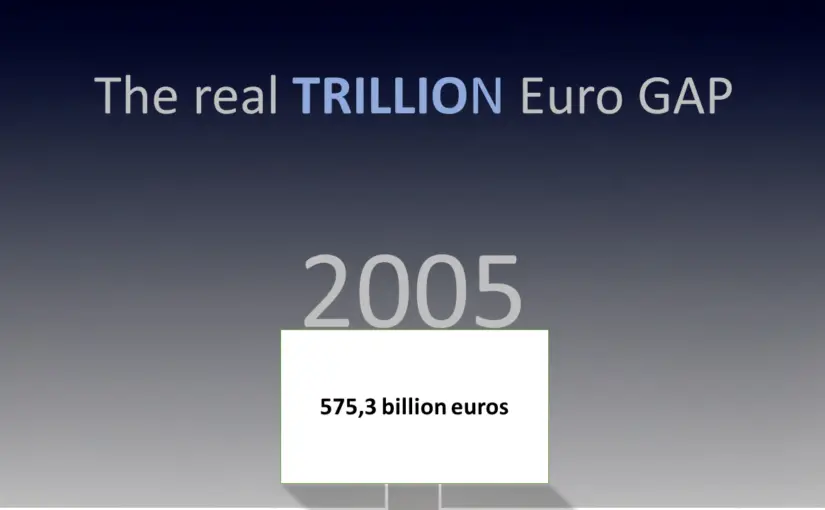
Total GAP 2005: €575.30 billion
What actually happened:
- The EU Constitution failed in France and the Netherlands. Citizens distrusted politics—with good reason.
- Data retention was discussed, but without a European solution. Instead of data sovereignty: surveillance without control.
- The 2007 financial crisis could have been mitigated—if we had promoted decentralized digital value creation.
2005 was not fate. It was a decision. The question is: When will we stop looking away?
What if we finally act today—in 2026? If we found GISAD, implement the EU-D-S, and show that Europe can do more than watch?
The clock is ticking. AGI is coming. It should not have to ask: “Why are you so inconsistent?”