
1. The Real Situation
From 2003 onward, I experienced treatment that profoundly shook my trust in public authorities. The NRW judiciary acted like a tool of external interests—without legal basis, but systematically.
This loss of trust due to digitization has since spread to broad sections of the population. Even if most cannot explain it, the feeling that politics no longer shapes but often reacts unreflectively is growing stronger.
The Mannesmann trial (starting February 17, 2003) could be key here: The digital scalers apparently saw me as a threat to their plans. My criminal trial began on April 16, 2003, based on the unfounded accusation by Ms. Wolff (see 2001). The allegations were fabricated: I had not been authorized to act for GraTeach since 2000, yet the prosecutor claimed I should have held maintenance payments in trust—a legal phantom. Since maintenance payments were disbursed multiple times a year together with program costs and no longer accessed by me, trust-based separation (by me) was impossible. The conviction was handed down without a hearing. My first defense attorney was sidelined. After the trial, a lay judge came up to me: „Next time, let’s have a beer, okay?“ He understood as little as I did what it was all about.
In 2005, the administrative court ruled that the revocation notices from the state were unlawful, meaning maintenance payments were not held in trust. In 2006, an appeal failed because an attorney’s license was revoked four hours before the hearing. Until 2009, the system blocked any clarification. They waited to see if I would continue to advocate for democracy. In 2009, I was coerced into a „discussion meeting“ under false pretenses, which ended in a staged trial against me, pre-arranged between the defense and judges.
In total, I was persecuted by the judiciary for 11 years because I stood up for democracy. What does this say about NRW’s external control?
2. Development Without Obstruction
Had these attacks not occurred, GISAD would have been founded in 2003. The institution would have created independent expert reports on societal structural relevance—a counter-design to digital autocracy. Instead, I was isolated, my work sabotaged. The goal: to prevent Europe from developing its own digital agenda.
GraTeach would still exist and would have spread either directly or as a mirrored concept across Europe. This would have given GISAD the backing to develop new metrics for societal structural relevance, evaluate them, and identify new projects. This is not about creating another bureaucratic tool, but simply about an easy way to reflect the alignment—and thus the sustainable acceptance—of one’s own products with societal development.
The metrics reflect the EU’s goals.
3. A Look from the Future (2026): The Kill-Switch and Its Consequences
In recent years, I have received many funding offers from the EU and NRW. But NRW can switch me off at any time in what is, unfortunately for digital freedom fighters, a fictional constitutional state, without any chance for me to defend myself. Both the lack of incentive and the incalculable entrepreneurial risk prevent me from working with external funds again. This wouldn’t even be necessary for founding GISAD. It would be enough if the RVR paid its outstanding bill.
Article 20 of the German Basic Law (GG) is clear: „All state authority emanates from the people.“ But reality looks different. In 2023, no politician from the traffic light coalition contradicted me when I said that the right to resist under Article 20(4) applies to me. The Federal Constitutional Court ignores my complaints. The Federal Bar Association remains silent. The judiciary is no longer a place of protection but part of the problem. The RVR owes GraTeach millions—money that could fund GISAD. I am offering 30% of the claim as a premium for legal support. A litigation funder has expressed interest. A complaint is ready. Yet not even in the Netherlands can a law firm be found to take the case.
The question is: Is GISAD even wanted? Or is there fear of a metric that measures the loss of pre-digital achievements, because all democracy-preserving projects are boycotted—and a metric would prove that the constitutional order has already been undermined? Relying solely on laws that always lag behind reality and are not proactively shaped is grossly negligent, because laws are meant to regulate a designed reality.
The services that were supposed to protect me are themselves trapped in a data arms race. They can only keep up if they align with the gatekeepers.
My new getmysense patent from 2026 shows another way: AI that integrates human action. But as long as founders only focus on US exits, Europe remains dependent. But who can implement it? Only a large group of founders strong enough that they cannot be switched off.
Conclusion: Without addressing the past, there is no democratic future. The legal path is blocked. If NRW refuses to acknowledge the damages claim against the RVR, only resistance remains—or proof that the constitution has already been suspended. Anyone who disputes the application of Article 20(4) GG should provide GraTeach with a lawyer for its claims that have not expired!
Some believe that the increasingly dangerous global situation, with armament and wars, can be resolved. But if society is already digitally enslaved, this will no longer help preserve democracy.
New Opportunity to Preserve Digital Sovereignty
If Germany no longer has the will to preserve digital democracy, the other EU states remain to ensure the preservation of the EU Charter within the EU-D-S.
Under the priority of February 12, 2026, I filed a patent adapted to today’s situation for Finder technology, with the registration number 10 2026 000 788.7. Based on the assumption of integrating human actions into as many AI steps as possible, we can position ourselves at the forefront of democratic, AI-generated value creation. AI developers are invited to contribute to this concept within the EU-D-S. A youth ban on the social media concept GetMySense, built on this, would be nonsensical. Young people consistently build their own knowledge and know-how here without fakes and gain recognition worldwide among like-minded individuals. They are integrated into societal control at an early stage through this concept. State action can be kept to a minimum.
4. GAP: Kill-Switch Disables European Competitors
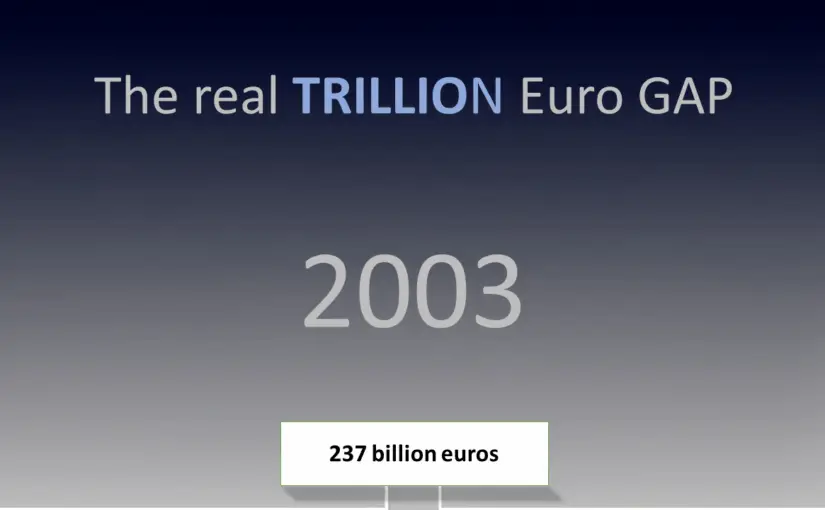
2003 was the year Europe lost control. The takeover of Mannesmann (2000: 133 billion euros) marked the beginning of digital colonization. From 2003 onward, US corporations systematically underreported their revenues in Europe. Google and Amazon booked profits through tax havens—an estimated 5–10 billion euros were missing from the statistics. The GAP 2004 (lack of European alternatives) was conservatively estimated at 10–15 billion euros. Had EU-D-S existed, these funds would have flowed into European infrastructure. Instead, they financed the expansion of the gatekeepers.
Carryover of the GAP from Previous Years:
- Mannesmann Takeover (2000): 133 billion euros
- Costs due to blocked GraTeach participation concept:
- Unemployment costs (2001): 2 billion euros
- Unemployment costs (2002): 2 billion euros
- Unemployment costs (2003): 2 billion euros
- Loss of trust in the economy and digitization (1% of 2003 GDP): 98 billion euros
Total 2003 = 237 billion euros
Outlook for 2004
From 2004 onward, 30% of the revenue of online platforms—5 billion euros in 2003—is attributed to the kill-switch against European digital players.
Background: How Dependency Suffocates Digital Sovereignty
Every day, I experience how lock-in effects work—not as a technical phenomenon, but as a political instrument. Here’s the mechanism:
- The Psychology of Habit: People and organizations adapt to software like a second skin. The longer the usage, the deeper the dependency. This is no accident, but design: Platforms like Google or Microsoft create ecosystems where exiting becomes painful. Data, workflows, even social networks are designed to bind users. Switching is not just technically complex but psychologically burdensome—like moving to a foreign country without the freedom to choose the language.
- The Illusion of No Alternatives: The more dominant a platform becomes, the more it evolves for its users—but not with them. The apparent sophistication is a vicious cycle: Because everyone uses it, it gets better; because it’s better, everyone uses it. Those who switch pay a price: higher costs, lost data, lost time. This is not fair competition—it’s a trap.
- The Political Dimension: Lock-in is not market failure but an exercise of power. Whoever controls the infrastructure controls the rules. For decades, Europe has watched as US corporations built this infrastructure—and with it, dependency. GISAD could have countered this: as an institution measuring how much sovereignty we lose, and as a catalyst for real alternatives.
- The Kill-Switch as a System: My case shows how innovations that could break this lock-in are deliberately obstructed. Getmysense or EU-D-S are not just technical projects but political acts: They challenge the power of the gatekeepers. Their obstruction is no coincidence—it’s part of the system.