
1. Real Situation in 2007: A Remote-Controlled System That Intimidates and Blocks Innovation
Imagine being confronted year after year with a dysfunctional system. What does that do to you? I only defined the Organized Gang-Like Pattern of Appearance in 2023. After each of my initiatives for democracy, the state repeated the same pattern of behavior:
- The NRW response letter to GraTeach of June 17, 2009, to the ghostwriter letter from a lawyer (2007) used delay tactics to calculate 5% interest above the base rate (€4,146.99) – based on an allegedly enforceable judgment, with the cynical note that it could only be overturned by filing a new lawsuit.
- The administrative court ruling from 2005 had not found any pre-insolvency breach of contract. The insolvency administrator was responsible for the post-insolvency failure to utilize assets, but due to a poorly worded settlement, a percentage payment obligation was shifted onto us – under threat of enforcement by the district government.
- The professional disqualification of the lead attorney in 2006 paralyzed the judiciary until 2009. No judge dared to dismiss the proceedings, even though the principle of “in dubio pro reo” should have required the public prosecutor to drop the case.
- Proportionality? Nonexistent. NRW never denied causing the insolvency itself by breaking promises and placing GraTeach in a worse financial position than others (more on this).
Conclusion: A remote-controlled system that intimidates even civil servants, leaves judges and lawyers in the lurch, and is hostile to innovation. In a constitutional state, NRW would have to answer for the societal damage amounting to billions. But a new government is quickly elected – and no longer feels responsible.
2. Development Without Obstruction: Digital Sovereignty Through Participant Protection and Preservation of European Values
Data protection protects data – but not the participants who generate it. Gatekeepers exploit this: They deprive citizens of control over their data and monopolize value creation. My approach of participant protection through WAN anonymity (my patents from 2017 were technically feasible as early as 2007) would have changed this:
- Combating fake news without censorship: With WAN anonymity, it is possible to prevent manipulation without restricting personality rights. Only in individual cases can forensic traces be secured by court order.
- Digital identity as a civil right: Instead of losing data to corporations or states, citizens would have a digital home – a place where they can sovereignly decide with their own key about their digital property.
- Value creation for all: WAN anonymity enables business models that include all participants. Gatekeepers receive a fair share of the value creation – not everything.
- Technical basis: My three patent applications for the Personal Digital System show: It is never about technology for its own sake, but about transferring pre-digital principles (e.g., freedom of assembly, property protection, inheritance) into the digital world.
Core difference from gatekeepers: They focus on global expansion and data monopolies. The EU-D-S aims to unite all Europeans in a Digital Union – with fair value creation and democratic control.
3. Perspective from 2026: Why Europe Missed the Opportunity – and How to Move Forward
The irony: As a graduate pedagogue, I developed the core formula of today’s AI (tokenization) and a category system as early as 1999 that could have broken the power concentration of the gatekeepers. With Mannesmann Mobilfunk (from 2000), I could have spread the concept of diversity and distributed value creation across Europe.
Why has Trusted WEB 4.0 failed so far?
- Power concentration: Gatekeepers and states want control, not participation.
- Legal inertia: Instead of using WAN anonymity (which requires no new laws!), the focus was on anonymity on the one hand and total surveillance on the other – a concept for manipulation, not protection.
- Lack of citizen orientation: Digital laws are made “for” people, not “with” them.
The solution: Transferring pre-digital principles – blockchain can be the technology in the background! A judge immediately understands WAN anonymity: It corresponds to the pre-digital procedure (e.g., trust stations, comparable to a lawyer).
Europe’s competitive advantage: Fairness and sustainability are not obstacles, but the only way to compete against the gatekeepers. With WAN anonymity, a flood of new digital laws could be avoided – because pre-digital rights already regulate everything.
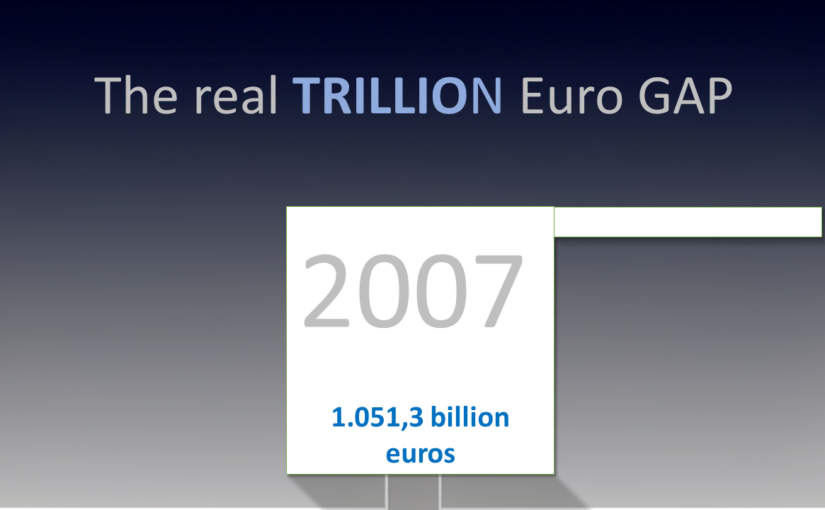
4. GAP 2007
Carryover from previous years:
- 2000: Mannesmann takeover – €133 billion (loss of European sovereignty)
- 2001–2006: Blockade of GraTeach – €15 billion (unemployment, lost innovation)
- 2004–2006: Revenue losses due to US platforms – €9.3 billion + €21 billion = €30.3 billion
- 2003–2006: Loss of trust in the economy & digitization – €98 billion + €143 billion + €180 billion + €189 billion = €610 billion
GAP 2007:
- Costs of unemployment due to lack of digital strategy: €3 billion
- Loss of trust in the economy & digitization (2% of €11.8 trillion GDP in 2006): €236 billion
- Revenue losses due to US platforms (30% of €80 billion): €24 billion
Total GAP 2007: €1,051,3 billion
Background: In 2007, several events shook confidence in digitization:
- Data protection debacle with anonymized databases (SPIEGEL, December 2007).
- Critical discussions about big data and lack of sanctions (EU opinion).
- Growing skepticism toward US platforms (Google, Facebook, Amazon) and their data practices.