
1. Real Situation 2010: Systematic Destruction – No Accident, but Strategy
Three years of probation until 2012 in the GraTeach case without legal basis and without a hearing: a professional ban on democracy work, while I secretly developed getmySense—a concept for inclusive digital participation that became dangerous to foreign powers profiting from dependency and control. The methods used against me were not isolated incidents but part of a pattern:
- Kamp-Lintfort (SPD-led city): Active involvement in the GraTeach insolvency—a deliberate attack on European digital sovereignty.
- NRW (SPD-governed): Judicial remote control and economic sabotage against innovators like me.
- RVR (SPD-dominated): To this day, copyright infringements amounting to millions in favor of US platforms, at the expense of European pioneers.
- Dortmund start2grow competition (SPD-governed): After 25 years as an expert and coach without a single criticism, I was simply shut down in 2025 because I invited founders to join the EU-D-S.
Four times SPD—four times systematic failure. This is not a coincidence, but political intent: Those like the SPD, who have courted non-European corporations since the 2000s and ignored citizens‘ rights, are deliberately destroying the foundation for a European digital economy.
The consequences?
Psychological torture (Amnesty criteria met after 11 years of judicial arbitrariness), economic destruction, and a climate of fear for anyone daring to propose alternative models.
Jean Améry was right: „Whoever has been tortured remains tortured.“ Every attempt to re-establish myself as an entrepreneur after 2009 ended in panic attacks and blackouts—even in 2024, in the same courthouse where I was defamed for years with the characteristics of a „gang-like appearance.“ Anyone who experiences this knows: This SPD-shaped system is not about justice, but has learned to bow to US power remotely. Even if the rule of law were to be restored, my subconscious (despite being self-employed since the age of 20) will no longer allow me to take risks with borrowed capital.
If NRW simply pays its RVR bill, I will use the resulting equity with GISAD to establish the EU-D-S as a central instrument for a sovereign Europe.
2. Development Without Obstruction: What Could Have Been
Without the systematic blockade by the SPD, getmySense could have launched as a European lighthouse project as early as 2002. Instead, the opportunity was missed to create a digital infrastructure that keeps value creation in Europe—instead of ceding it to US gatekeepers.
- Decentralized platforms would have strengthened local value creation and even enabled the formation of digital property for individuals, rather than pushing them into dependency on Google, Amazon & Co.
- Open standards would have broken the dominance of proprietary systems (such as Microsoft Office or iOS) and kept European tech talent on the continent.
- Digital cooperative models would have limited the power of gatekeepers and enabled fair value creation.
But the SPD continued to rely on central US big industry—and consciously ignored the needs of its own clientele: the workers, whose digital value creation is now being siphoned off by US corporations. The SPD cannot think digitally from the citizen’s perspective!!
3. View from the Future (2026) – Why the SPD Considers Gatekeeper Development as „Natural“
The SPD, traditionally closely linked to big industry, saw the expansion of gatekeepers not as a threat, but as a logical development. Why?
- Short-sighted job guarantees: The SPD believed that cooperating with digital US corporations could secure jobs in Germany. The fact that these corporations would long-term drain European value creation was ignored.
- Illusion of control: They trusted that „German champions“ (like Siemens or Volkswagen) could compete globally—without recognizing that the digital infrastructure was already dominated by US platforms.
- Downplaying dependency: Instead of demanding digital sovereignty, the SPD accepted „smart dependency“ as the price for short-term investments. Examples:
- Cloud computing: Instead of promoting European alternatives, authorities and companies were encouraged to store data with AWS or Microsoft Azure and to use US surveillance software like Palantir—with fatal consequences for long-term dependencies and compatibility with European data protection standards.
- The introduction of data retention is advocated without prioritizing WAN anonymity to protect personality rights.
- Social media: Facebook and Google were celebrated as „innovative,“ while European alternatives like digital education in Trusted WEB 4.0 were systematically obstructed. Special emphasis is placed on integrating all social groups, including SPD voters.
- E-government: Instead of investing in decentralized, user-controlled solutions, money was poured into expensive, inefficient central projects—now considered „digitalization disasters.“
The SPD thus sacrificed Europe’s digital future for an illusion of stability—and betrayed its own clientele, whose jobs are now threatened by algorithms and platform economics.
From the perspective of a digital society, there are several reasons why the SPD should not be voted for in the 2027 NRW state elections:
- Lack of worker inclusion
The SPD traditionally sees itself as a workers‘ party but has failed to reach industrial workers for years. Many workers fear social decline and no longer feel represented by the party. Instead of offering concrete solutions to the digital and social challenges of the working world, the SPD remains trapped in old structures. The party’s „listening tours“ and promises often seem like symbolic politics, without real participation or co-design by those affected. The SPD has failed to actively involve workers in the digital transformation and to strengthen their interests together with all other groups in the digital society.
- Failures in the digital society
The SPD has not presented a convincing digital agenda in NRW that meets the requirements of a modern, inclusive society. While there are inquiry commissions such as „Artificial Intelligence – For a Smart State in the Digitalized Society,“ concrete measures for digital sovereignty, the promotion of digital cooperative models, or the strengthening of citizens‘ digital rights are lacking. Instead, classic state-led topics such as centrally controlled education and daycare centers dominate, while digital infrastructure and the participation of all in digital value creation are neglected. The SPD has failed to seize the opportunities of digitization for greater social participation and economic justice—a central failure in a time when digital skills and infrastructure determine ascent or decline.
- Lack of credibility and identity crisis
The SPD suffers from a profound identity crisis. It is losing voters to the AfD and other parties because it is perceived neither as a modern digital party nor as a reliable representative of workers. The party appears torn between traditional milieus and the demands of a digital future. The failures in digital policy and the lack of grassroots involvement show that the SPD has lost touch with the needs of a digital society.
Conclusion
Anyone who wants to shape a digital society that includes everyone and distributes the opportunities of digitization fairly will not find a convincing force in the NRW SPD. The party has neither led workers into the digital future nor developed a clear vision for a digitally sovereign NRW. For voters who want an inclusive, digital, and participatory society, FDP people’s party positions itself as a better alternative.
Voters in NRW should only choose a party that convinces them it will free them from occupation by the gatekeepers. An election result for the SPD below 5 percent in the state elections would be appropriate.
4. GAP 2010 – The Price of Failure
Carryover from previous years:
- 2000: Mannesmann takeover – 133 billion euros (loss of European sovereignty)
- 2001–2007: Unemployment due to GraTeach blockade – 18 billion euros
- 2004–2006: Revenue losses due to US platforms – 54.3 billion euros
- 2003–2009: Loss of trust in economy & digitization – 1,422 billion euros
- 2009: Cyber damages – 24 billion euros
- 2008: Financial crisis (10% of 5.1 trillion) – 510 billion euros
GAP 2010:
- Loss of trust (3% of 2009 GDP: 12.3 trillion) – 364 billion euros
- GDP decline in the EU (2008–2009) (30% of 600 billion) – 200 billion euros
- Damages due to wrong digital strategy (30% of 120 + 85 + 30 billion) – 70.5 billion euros
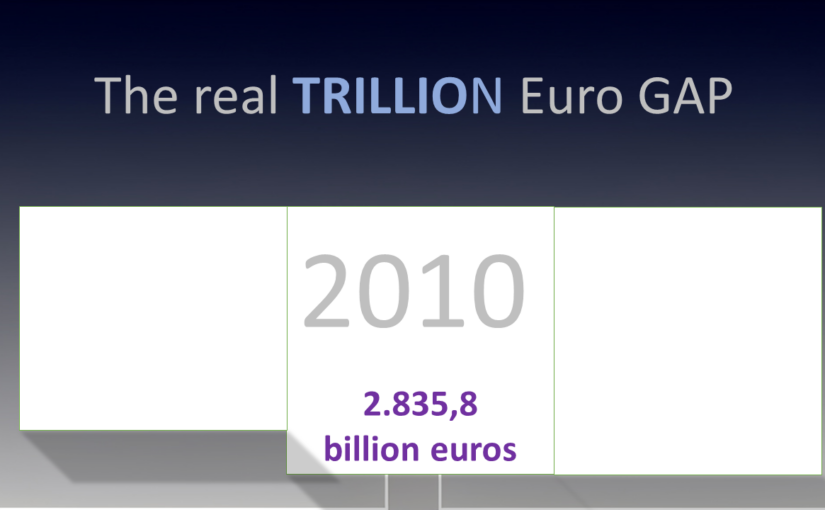
Total GAP 2010: 2,835.8 billion euros
Main topic 2008-2009:
The global financial crisis exposed the failure of opaque financial markets and the dependency on non-transparent digital information chains. Ad-driven platforms and manipulated ratings exacerbated the crisis. The bank bailout was already accounted for in 2008. Now, the damages from the GDP decline have also been included.
Main topic 2010:
Europe relied on digital solutions without retaining control over data and infrastructure. The introduction of smartphones, cloud services, and social networks accelerated the concentration of power among US gatekeepers. At the same time, Stuxnet, data scandals, and cyberattacks revealed the continent’s vulnerability.
Precise damage in Europe 2010:
- 120 billion euros due to cyberattacks and data leaks (Stuxnet, industrial espionage).
- 85 billion euros due to missed digital value creation (acquisition of European start-ups).
- 30 billion euros for inefficient e-government projects.
Trusted WEB 4.0 technologies such as Finder (1999), getmysense (2002), GISAD (2003), EU-D-S (2004), and WAN anonymity (2007) could have served as the foundation for a European digital alternative.