
1. Real Situation in 2011: Simply Carry On?!
During the three-year probation period related to GraTeach, I worked intensively on preparing the launch of getmySense for 2012. Before the probation ended, I did not want to risk going to prison by re-engaging in efforts to preserve democracy. I programmed the project myself and implemented it without third-party funding. Distribution was to be handled by external agencies, and a partner for the German-speaking market had already been found. Additionally, a private investor was ready to finance expansion after a successful pilot project. To increase visibility, I submitted an application for the ECO Internet Award 2012.
2. Development Without Obstruction: What Could Have Been!
With GraTeach, I had already demonstrated that it takes about a decade for new ways of thinking to become socially established. A generation spans an average of 25 years—but it would have been enough if the 18-year-olds of 2011 had grown up with Trusted WEB 4.0. They would have first encountered getmySense in 2002, at the age of nine, and learned that the internet is not just about fun but also about inspiration. Schools could have critically discussed the design of a digital society early on. Students could have increased their pocket money by uncovering fake news. Compensation and deductions for fake news would be handled automatically. The penalty for fake news is calculated so that the system operates cost-neutrally through automatic micropayments. Thanks to the WAN anonymity concept, every user receives automatic payment access upon their first registration in the EU-D-S, without having to worry about data privacy. Even before university, some could focus on specific areas through the category concept and build a reputation by contributing or identifying errors (which are often unintentional). Recognition in a category within the EU-D-S could offset a poor school grade.
Those over 20—university graduates and master craftsmen—could have used the digital, interdisciplinary year developed by GraTeach to prepare themselves for the digital society while also giving back through projects at the digital site. The duration of the „year“ could have varied between two months and two years. Companies could have covered the internship fee upon hiring, while the public sector would only act as an interim financier. A win-win situation for all involved.
3. Perspective from the Future (2026): Is It Too Late to Change Anything?
Democracies review decisions through a process involving many institutions—which is good as long as it is proactive. However, within the EU, institutions increasingly block each other, and responsibility is avoided. Political decisions are only made where there is a risk of losing voters. Yet even this mechanism fails, as the example of the SPD shows.
The turning point must come from the economy, often perceived as purely profit-driven. But scalable business models are limited and controlled by a few US corporations. Every time I initiate meaningful digitalization efforts, I am not only hindered by gatekeepers but also by a remotely controlled public sector. This shows that value creation is distributed more unequally, and the decision on (the lack of) digital sovereignty lies with the gatekeepers.
With the EU-D-S, I have developed a concept based on the EU Charter that enables European companies to compete against gatekeepers through dynamic monopolies. What is needed is a fund that focuses on long-term European growth—not on a US exit.
4. GAP 2011: The Price of Failure
2011 once again highlighted how gatekeepers pollute the internet just as oil pollutes water. A loss of trust equivalent to 5% of EU GDP (€740 billion) is a conservative estimate. For comparison: In 2011, the digital economy accounted for 4.8% of US GDP.
Carryover from Previous Years:
- 2000: Mannesmann takeover – €133 billion (loss of European sovereignty)
- 2001–2007: Unemployment due to GraTeach blockade – €18 billion
- 2004–2006: Revenue losses due to US platforms – €54.3 billion
- 2003–2010: Loss of trust in economy & digitalization – €1,826 billion
- 2008: Financial crisis (10% of €5.1 trillion) – €510 billion
- 2009: Cyber damages – €24 billion
- 2010: Flawed digital strategy – €70.5 billion
- 2010: GDP decline in the EU – €200 billion
GAP 2011:
- Loss of trust (5% of 2011 GDP: €14.8 trillion) – €740 billion
- Cyberattacks (30% of €30 billion) – €9 billion
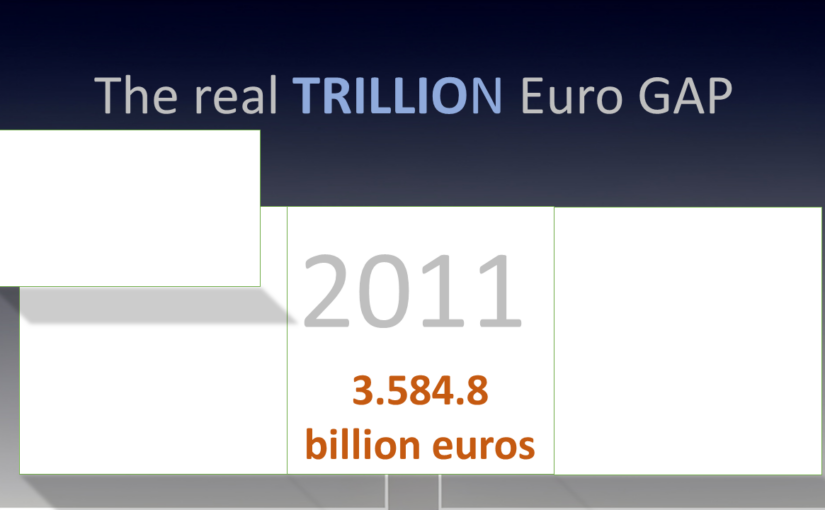
Total GAP 2011: €3,584.8 billion
Defining Events of 2011:
- PlayStation Network Hack: 77 million user data records stolen, €5 billion damage in Europe (Source).
- Operation Shady RAT: Industrial espionage in 14 countries, €25 billion damage in Europe (Source).
Conclusion: The events of 2011 underscore the urgent need for European digital sovereignty. Without it, Europe will continue to depend on gatekeepers and cyberattacks—at immense economic and societal costs.
Trusted WEB 4.0 technologies such as Finder (1999), getmysense (2002), GISAD (2003), EU-D-S (2004), and WAN anonymity (2007) could have served as the foundation for a European digital alternative.