
The digital transformation of democracy is at a decisive turning point. The study Adaptation of Political Elections and Parties to Permanent Digital Feedback Mechanisms in the Context of a Digital Democracy (particularly in the “Trusted WEB 4.0”) shows: real-time feedback systems, category-based elections, and digital tools can make political processes more transparent, more inclusive, and more resilient against authoritarian tendencies. A central finding of the study is particularly important: the EU-D-S is not aimed at all citizens, but at a target group with an active interest in permanent political participation – which is precisely why the risk that the permanent feedback will not work is significantly lower than in the comparison projects. At the same time, the analysis warns of the risks: manipulation, digital division, and the loss of democratic achievements if no holistic solution is implemented.
1. Real Situation: Probable Scenario Without Trusted WEB 4.0
Democratic and liberal forces are coming under increasing pressure. Right-wing parties with simplistic messages are gaining influence – not because of better policies, but because of their masterly use of digital manipulation. Society is resigning itself because it senses: “My vote does not count.”
The problem, however, does not lie with the politicians, but with a society that neglects pre-digital democratic achievements.
AI-driven manipulation in small, barely noticeable steps is undermining trust in democratic institutions. Committed politicians who fight for diversity and transparency are being attacked in a targeted manner and are losing visibility. The result is an anticipated digital autocracy in which elections ultimately no longer play a role. Many citizens will regret their voting decision – when it is too late.
2. Development Without Obstruction: With Broad European Support Since 2027
Permanent digital feedback mechanisms and category-based elections hold the potential to make political systems more democratic, more transparent, and more inclusive. The study confirms: real-time feedback systems increase citizen participation, break the dominance of interest groups, and strengthen political diversity.
Blockchain-based solutions, as tested in Estonia or India, offer secure, tamper-proof voting.
Lobbying is being redefined – not as opaque influence, but as transparent economic and citizen participation. Digital platforms make it possible to divide political topics into categories and, where needed, to hold partial elections at staggered times. This breaks the concentration of power among individual groups, and authoritarian tendencies are losing ground.
Target group of the EU-D-S – not all citizens: The EU-D-S does not assume that all citizens will take part. Those who should participate are people who bring an active interest in long-term political engagement and, possibly, in freeing themselves from a poor social position. Citizens who, because of their upbringing, do not feel able to make their own decisions, or who are dependent on social media, will not participate in the EU-D-S and are not wanted there either. Without active interest, permanent participation makes no sense – the target group of the EU-D-S sees precisely this as its purpose and therefore participates on a permanent basis.
Social welfare and participation: The state will not be able to roll back social welfare completely. However, for those who actively want it, it can alternatively assume slightly higher participation payments in the EU-D-S – processed via the EU-D-S’s own payment system. This goes hand in hand with social recognition, because no social welfare is received any more, and with the chance to free oneself from one’s own situation. This offer, too, follows the principle of active interest: it is not an automatic benefit for everyone, but an alternative for citizens who consciously choose the path into the EU-D-S.
Successful examples from the study:
- Estonia: E-voting systems since 2005, secure and transparent elections with high citizen acceptance.
- India: Projects such as “Lakshya” and “PaHaL” reformed the distribution of subsidies through digital feedback systems, increasing efficiency and transparency.
- New Zealand: “SmartStart” connects parents and healthcare providers and improves the quality of services.
- Kenya: Mobile voting systems increased the political inclusion of marginalized groups.
Failed approaches:
- Hybrid regimes: In some countries, digital feedback mechanisms were used for surveillance and the suppression of the opposition instead of strengthening democracy.
- Limited digital skills: In countries with weak infrastructure (e.g. parts of Africa or Latin America), digital democracy projects failed due to a lack of participation.
- Data protection scandals: In Europe, insufficiently regulated digital voting systems led to a loss of trust (e.g. pilot projects in Germany and Spain).
Technical feasibility is a given. But without clear legal and ethical frameworks – without the European Digital System (EU-D-S) – these approaches remain isolated. They will not prevail against established digital autocracies. The target group is decisive here: the risks mentioned mainly affect systems that want to include the entire population. Since only citizens who see a purpose in permanent political participation take part in the EU-D-S, the risk that the permanent feedback will not work is significantly lower than in the comparison projects.
3. Demands from the Perspective of 2026
The holistic approach of the EU-D-S is needed. Individual projects such as Finder (1999), getmySense (2002), GISAD (2003), EU-D-S (2004) and WAN anonymity (2007) are in harmony with this vision. But they need European support in order to prevail against the gatekeepers.
This is not about disruption, but about evolution. Politicians need time to work their way into their topics – legislative terms of 4 to 5 years are essential for this. Politics must proactively contribute ideas instead of being driven by digital monopolies. The EU must create the framework so that diversity is not only possible, but also viable.
4. GAP Analysis 2033
Carried forward from previous years:
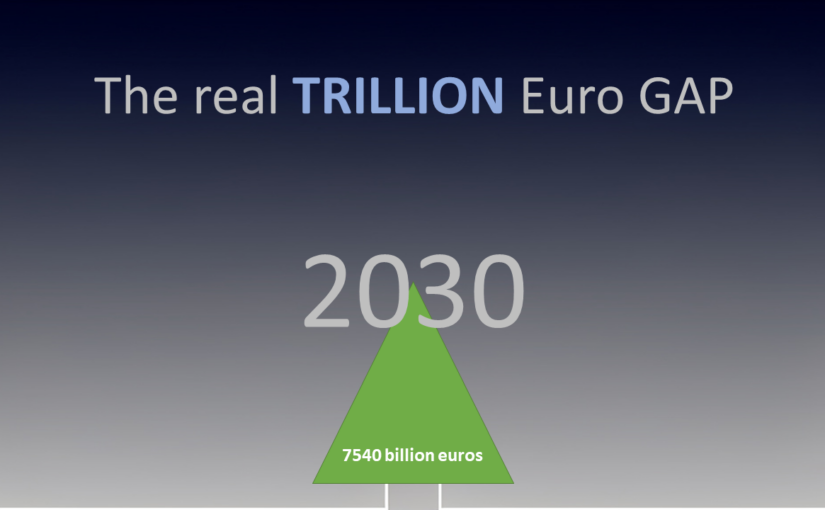
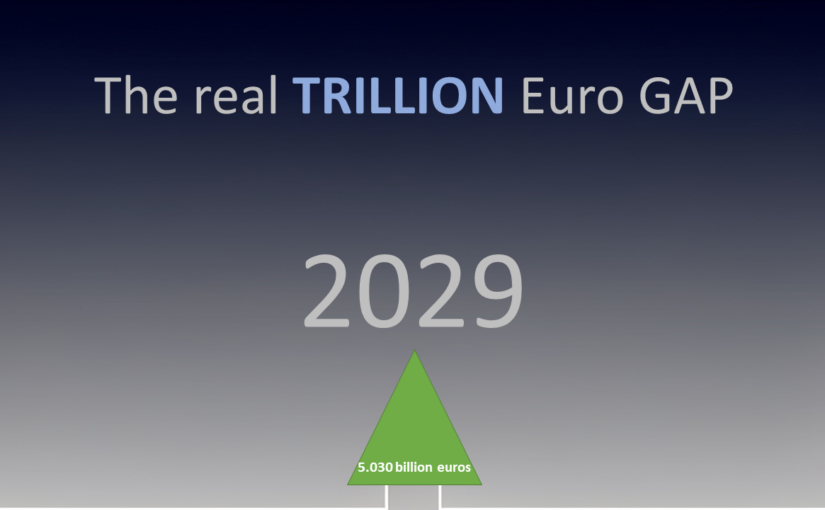
The EU-D-S is founded in 2027. The GAP amount from 2026 of €45.74 trillion will be reduced annually by 2030 by the Total Trusted WEB 4.0 Bonus of a total of €7.54 trillion.
Development of the gatekeepers (Google, Amazon, etc.):
2025: Google (approx. €300 bn), Amazon (approx. €600 bn)
2026: Google (approx. €320 bn), Amazon (approx. €650 bn)
2027: Google (approx. €340 bn), Amazon (approx. €700 bn)
2028: Google (approx. €360 bn), Amazon (approx. €750 bn)
2029: Google (approx. €380 bn), Amazon (approx. €800 bn)
2030: Google (approx. €400 bn), Amazon (approx. €850 bn)
2031: Google (approx. €420 bn), Amazon (approx. €900 bn)
2032: Google (approx. €440 bn), Amazon (approx. €950 bn)
2033: Google (approx. €460 bn), Amazon (approx. €1 trillion)
Events in Europe that would have changed with the EU-D-S:
- 2014: Prevention of the annexation of Crimea through early digital networking of resistance forces.
- 2016: Defense against disinformation campaigns during the US elections and the Brexit referendum.
- 2020–2022: Faster and more effective response to the COVID-19 pandemic through decentralized data processing
(e.g. better coordination of vaccine distribution and lockdown measures). - 2022–2024: Greater resilience against cyberattacks on energy and health infrastructures in Ukraine
(e.g. prevention of blackouts through decentralized networks). - 2025: Prevention of election manipulation in France and Germany through secure digital voting systems.
- 2026: Successful defense against AI-driven disinformation campaigns during the European elections.
- 2027: Introduction of the EU-D-S as the European standard for digital democracy.
- 2028: Complete integration of the EU-D-S into the public administration of all EU member states.
- 2029: Reduced dependence on US gatekeepers through European alternatives (e.g. own cloud infrastructures).
- 2030: European digital sovereignty in critical areas such as AI, data management, and cybersecurity.
- 2031: Complete integration of the EU-D-S into the European capital markets, leading to a strengthening of the
European economy. - 2032: EU-wide introduction of real-time feedback systems in all municipalities.
- 2032: Participation payments via the EU-D-S’s own payment system for citizens who participate actively – social recognition, without social welfare being completely rolled back.
- 2033: EU-D-S as the global standard for digital democracy – an alternative to the authoritarian systems of the gatekeepers.
Trusted WEB 4.0 technologies such as
Finder (1999),
getmySense (2002),
GISAD (2003),
EU-D-S (2004)
and
WAN anonymity (2007)
would have served as the foundation for a European digital alternative without obstruction.
Conclusion: Without the EU-D-S, Europe will end up in a digital autocracy in which elections no longer play a role.
With the EU-D-S, a digital democracy can be built that guarantees diversity, transparency, and sovereignty – carried by citizens who participate permanently in politics of their own accord.
Sources
[1] A systematic analysis of digital tools for citizen participation – ScienceDirect
[2] Impact of Information and Communication Technologies on Democratic Processes and Citizen Participation
[3] Frontiers | Public opinion monitoring technologies: how the state uses data to make political decisions
[4] Full article: Artificial Intelligence and Data-Driven Technology in the Public Policy Cycle: Comparative Applications, Opportunities, and Risks
[5] The Impact of Electoral Systems on Democratic Governance
[6] Election Timing and the Electoral Influence of Interest Groups – Sarah F. Anzia
[7] Reimagining the Ballot: A Comprehensive Look at Primary and General Election Systems – R Street Institute
[8] Frontiers | Toward a new paradigm of convergence in lobby-state interactions: global challenges, communication, and transparency
[9] Lobbying | OECD
[10] How Lobbying Matters | Annual Reviews
[11] Designing Deliberative Lobbying: Three Institutional Solutions for an Open Lobby Democracy – Bitonti (2026) – The Political Quarterly – Wiley Online Library
[12] Towards Real-Time Governance: Using Digital Feedback to Improve Service, Voice, and Accountability | Center For Global Development
[13] Full article: Reconstructing elections in a digital world
[14] Government Feedback Mechanism: Unlocking Business Opportunities through Government Feedback Mechanism – FasterCapital
[15] Digital democracy in action: 5 lessons to support resilient democracies | Westminster Foundation for Democracy