The study „AI and the Natural Sciences 2034: Transformation of Education, Research, Trusted WEB 4.0“ shows: AI is fundamentally changing not only the natural sciences, but also education. At the same time, it warns of the risks of a digital autocracy if no holistic solution is implemented.
1. Probable Scenario Without Trusted WEB 4.0
Education systems to date were not designed from the perspective of the individuals, but serve a societal purpose. In the course of industrialization, large numbers of simple workers were needed. Today, the view is widespread that AI will replace jobs. At the same time, through search dependencies the gatekeepers create large numbers of people who are only able to work to a limited extent.
These business concepts have not been thought through beyond achieving the highest possible scaling in the short term. From the perspective of an autocratic power, that is not necessary either. Addictive behavior creates subjects who stay quiet as long as their level of agitation is kept up by scraps of information.
A digital autocracy emerges, in which the few rulers are still doing well even when the majority of the population is down on the ground.
AI could accelerate this development:
- Mathematics: AI solves problems that remained unsolved for decades (e.g. the „Unit Distance Conjecture“ in 2026). Yet without individual support, many people remain excluded from this progress.
- Education: Traditional systems do not foster creativity or critical thinking. Instead, dependencies on gatekeepers emerge, who keep control through AI-driven manipulation.
- Research: Without Trusted WEB 4.0, closed systems dominate, in which only an elite has access to AI tools. The majority of people are degraded to passive consumers.
2. Development with Broad European Support for Trusted WEB 4.0
As early as 1985 it was found that every person is individually gifted and can deliver unexpected achievements when addressed individually. Trusted WEB 4.0 creates the framework to foster this diversity.
By 2027 at the latest, existing societal deficits will be offset for as many people as possible through an education concept that takes the diversity of people into account. It would have been better to introduce this concept back in 2006.
If the EU-D-S starts in 2027, realistically the first school systems will have switched to an individualized concept by 2032. It is up to a few motivated classically trained people to listen to their own voice and show in getmySense which individual abilities they possess. Hopefully these role models will be enough!
When the information and abilities of all people can be made available at any time, democracies also gain a significant economic advantage. This requires a value system that rewards unique selling points.
Examples from the 2034 study:
- AI in mathematics: Solves complex problems and fosters new proof techniques. Human researchers adapt these methods and refute further conjectures.
- AI in education: Pilot projects in North Rhine-Westphalia show how generative AI supports individual learning processes in the classroom (e.g. proving that the interior angles of a triangle sum to 180 degrees).
- AI in research: New methods of knowledge generation and validation are emerging. Interdisciplinary collaboration is fostered by AI.
- Human–AI collaboration: Iterative, dialogue-based models with feedback lead to better results than static input–output scenarios.
AI can help ensure that information is available exactly when it is needed and that everyone is integrated into the system according to their individual abilities.
Trusted WEB 4.0 as an enabler:
- Trustworthiness: Decentralized, transparent platforms ensure security and trust in AI applications.
- Education: Professional development for teachers and adaptive learning systems are provided.
- Research: New methods of knowledge generation and validation emerge through AI.
- „Digital Year“: A 3–24-month interdisciplinary scholarship (modeled on GraTeach) for executives could, if transferred to school projects, prepare people early on for a flexible digital future.
3. Demands from the Perspective of 2026
It is correct that more and more simple jobs can be automated and that low-skilled people are no longer needed. Autocracies will promote individuality only to a very limited extent. Only conforming people are easy to rule.
In 2026, we live in a world of digital aimlessness. Politics is ineffectively solving problems for a societal structure that will collapse if it does not adapt to the speed and possibilities of technological development.
Democracies are currently being put under pressure by autocracies, because they have not consciously transferred the strength of individual achievement for the community to a digital concept. That is exactly what Trusted WEB 4.0 does.
We stand at a crossroads. Only if we succeed in inspiring as many people as possible in the short term to embrace a society in which it is worthwhile for every person to seek out and develop their individual strengths will it still be possible to establish a democratic digital counter-concept – in an emerging Digital Union, ideally through a worldwide association of all democracies.
4. GAP Analysis 2034
Carried over from previous years:
The EU-D-S will be founded in 2027.
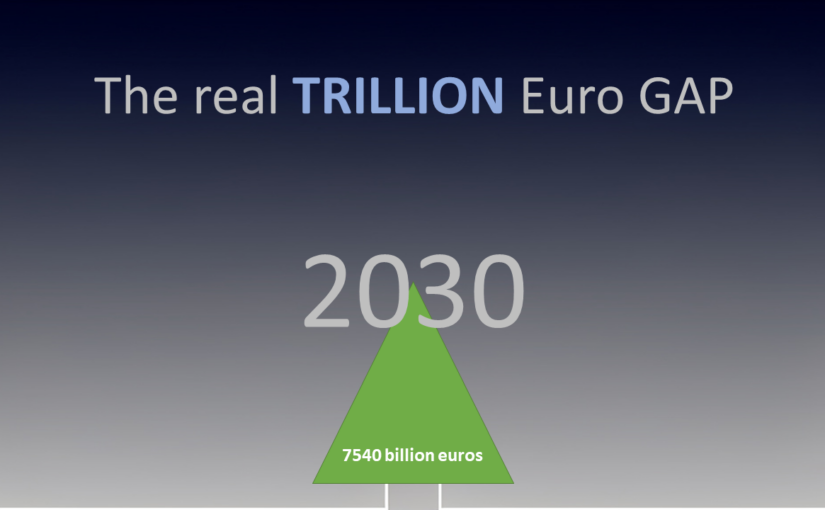
The GAP amount from 2026 of €45,74 trillion will be reduced by 2030 by the
Total Trusted WEB 4.0 Bonus of €7.54 trillion in total.
Development of the gatekeepers (Google, Amazon, etc.):
2025: Google (approx. €300 billion), Amazon (approx. €600 billion)
2026: Google (approx. €320 billion), Amazon (approx. €650 billion)
2027: Google (approx. €340 billion), Amazon (approx. €700 billion)
2028: Google (approx. €360 billion), Amazon (approx. €750 billion)
2029: Google (approx. €380 billion), Amazon (approx. €800 billion)
2030: Google (approx. €400 billion), Amazon (approx. €850 billion)
2031: Google (approx. €420 billion), Amazon (approx. €900 billion)
2032: Google (approx. €440 billion), Amazon (approx. €950 billion)
2033: Google (approx. €460 billion), Amazon (approx. €1 trillion)
2034: Google (approx. €480 billion), Amazon (approx. €1.05 trillion)
Events in Europe that would have been different with the EU-D-S:
- 2014: Prevention of the annexation of Crimea through early digital networking of resistance forces.
- 2016: Defense against disinformation campaigns during the US elections and the Brexit referendum.
- 2020–2022: Faster and more effective response to the COVID-19 pandemic through decentralized data processing
(e.g. better coordination of vaccine distribution and lockdown measures). - 2022–2024: Greater resilience against cyberattacks on energy and health infrastructures in Ukraine
(e.g. prevention of blackouts through decentralized grids). - 2025: Prevention of election manipulation in France and Germany through secure digital voting systems.
- 2026: Successful defense against AI-driven disinformation campaigns during the European elections.
- 2027: Introduction of the EU-D-S as the European standard for digital democracy.
- 2028: Full integration of the EU-D-S into the public administration of all EU member states.
- 2029: Reduced dependence on US gatekeepers through European alternatives (e.g. sovereign cloud infrastructures).
- 2030: European digital sovereignty in critical areas such as AI, data management, and cybersecurity.
- 2031: Full integration of the EU-D-S into European capital markets, leading to a strengthening of the European economy.
- 2032: EU-wide introduction of real-time feedback systems in all municipalities.
- 2033: The EU-D-S as the global standard for digital democracy – an alternative to the autocratic systems of the gatekeepers.
- 2034: Transition of the first school systems to individualized education concepts through the EU-D-S.
AI-supported learning systems are deployed across the board in schools and universities.
Trusted WEB 4.0 technologies such as
Finder (1999),
getmySense (2002),
GISAD (2003),
EU-D-S (2004)
and
WAN anonymity (2007)
would have served as the foundation for a European digital alternative without obstruction.
Conclusion: Without the EU-D-S, Europe will end up in a digital autocracy in which elections no longer matter.
With the EU-D-S, a digital democracy can be built that guarantees diversity, transparency, and sovereignty.
Sources
- 2034 Study: AI and the Natural Sciences – Transformation of Education, Research, Trusted WEB 4.0
- [1] Advances in artificial intelligence in mathematics and their impact on the professional community
- [2] Minister Feller: Exploring new learning opportunities with AI in mathematics and German | Land.NRW
- [3] AI and education • Körber Foundation
- [4] Artificial intelligence at universities (No. 59 / April 2021)
- [5] AI & Science – German UNESCO Commission
- [6] Artificial intelligence in science didactics – potentials, desiderata, challenges | Zeitschrift für Didaktik der Naturwissenschaften | Springer Nature
- [7] Generative AI & creativity: meta-analysis shows human–AI power – SciBlog.at
- [8] How human can artificial intelligence be? | EY – Germany
- [9] Understanding artificial intelligence and using it competently – DFG