1. The Real Situation in 2022: No Proactive Concept Against Hybrid Threats
In 2022, I experience a Europe stuck in a defensive posture. The digital dependence on gatekeepers—Google, Amazon, Meta—has long been a reality. At the same time, the Ukraine war escalates, fought not only militarily but, above all, digitally: disinformation, cyberattacks, and digital surveillance are the weapons of autocracies. The EU responds with regulatory attempts like the Digital Markets Act (DMA) and the Digital Services Act (DSA), set to take effect in 2023. However, these measures primarily aim for fair markets, not the digital sovereignty we urgently need to assert ourselves against the power of gatekeepers and autocratic states.
The costs of inaction are becoming increasingly clear:
- Cyberattacks and data breaches are on the rise, while Europe cannot present its own secure infrastructure.
- Ukraine is fighting for its existence, yet instead of creating a digital alternative that strengthens resistance in Russia, the West relies on military solutions.
- The gatekeepers dominate the market and, with it, political opinion-forming. Their platforms have become instruments of power that undermine democracies.
On June 13, 2022, I submitted the resolution proposal against the Ukraine war to the FDP. In it, I demand:
- Financial support for Ukraine to build a digital highway (1:1 VPN connections) between exile Russians and resistance forces in Russia.
- The establishment of GISAD as a central authority for developing standards that transfer pre-digital democratic achievements into the digital world.
The resolutions, supported by liberal EU delegates, were unanimous. But since Wissing was elected Digital Minister, seemingly important short-term challenges have shaped him. Since politics cannot prescribe proactive action to ministers, it is increasingly incapable of acting in an unshaped digital world.
2. Development Without Obstruction: Digital Democracy Offers Resilience Against Power Concentration
As I keep repeating: As early as 1999, the Finder technology could have laid the foundation for a secure digital identity. In 2002, getmysense—a system enabling social control through digital participation without sliding into surveillance—could have followed. In 2003, GISAD would have created the infrastructure for decentralized, anonymous, and structurally relevant standards. In 2004, the EU-D-S (European Digital System) could have served as the backbone of a European Digital Union. And in 2007, WAN anonymity would have added another building block for secure, manipulation-resistant communication.
Had we consistently implemented these technologies, Europe would not be dependent on American platforms today. Instead, we would have:
- Built a digital highway between exile Russians and resistance forces in Russia. For just 30 million euros (30 € per connection), one million exile Russians could have established secure 1:1 VPN connections with Russians in resistance—and thus accelerated the internal disintegration of the Putin regime.
- Used Ukraine as a pilot project to test a digital democracy infrastructure. The cost? Laughably low compared to the billions spent on weapons and reconstruction.
- Established GISAD as a central clearinghouse coordinating cooperatives for digital participation in every linguistic region—though this would require the executive to be willing to confront its past mistakes. This could generate billions in savings through more efficient use of EU funds.
3. Perspective from 2026: Only the Economy Can Fix This Now!
Today, four years later, it is clear: Only now does Russia see its internal security threatened by fuel shortages. A subversion through democratic concepts would have been bloodless, cheaper, and faster. The course for Europe’s current digital dependence was set by the gatekeepers‘ long-term strategy. Both OpenAI and Mythos spread the message: „We can attack everything. Don’t anger us!“ But autocracies will soon be able to do the same, waging a cyberwar on our backs—one that could have been prevented by decentralized structures.
Trusted WEB 4.0 could have already laid the foundation for a sovereign, democratic digital infrastructure back then. However, proactive politics are not to be expected in the future either.
The Neubaur response from August 12, 2025 exemplifies that politics still fails to understand: Instead of implementing concrete solutions like the EU-D-S, they refer to the DMA and DSA—as if regulation alone could conjure up digital sovereignty.
At the very least, one could expect a constitutional order to address past failures (letter to the president of the regional court) and accept the need to combat a gang-like phenomenon. Anyone can be part of this system today—even with the best intentions.
Only a coalition of as many parts of the economy as possible in the EU-D-S with guaranteed value creation can still largely preserve our pre-digital achievements. After 25 years of unchecked misdevelopment, I had to develop dynamic monopolies in the EU-D-S Constitution.
Whoever is the first to found a company in their category becomes Primus. As long as they serve their market, they remain unchallenged within the EU-D-S. If a founder in their field has a new idea, the Primus must integrate it or allow competition. Behind 1,000 categories are at least 1,000 specialized portals or a maximum of 2,500 different languages—a size that can resist the gatekeepers.
Every European company that thinks it can survive without the EU-D-S will be mistaken. AI is perfectly suited to implement the EU-D-S as a concept of diversity. Depending on the training data, AI can also be misused in the interests of a few. This directional decision is currently being made in the USA without us—if we do not act!
4. The 2022 GAP: What Non-Implementation Cost Us
Carryover from Previous Years:
- 2000: Mannesmann takeover – 133 billion euros (loss of European sovereignty)
- 2001–2007: Unemployment due to GraTeach blockade – 18 billion euros
- 2004–2006: Revenue losses due to US platforms – 54.3 billion euros
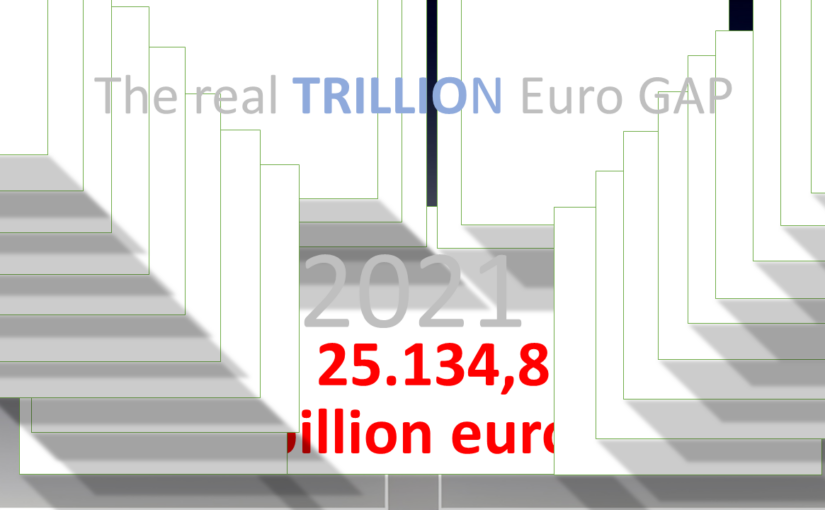
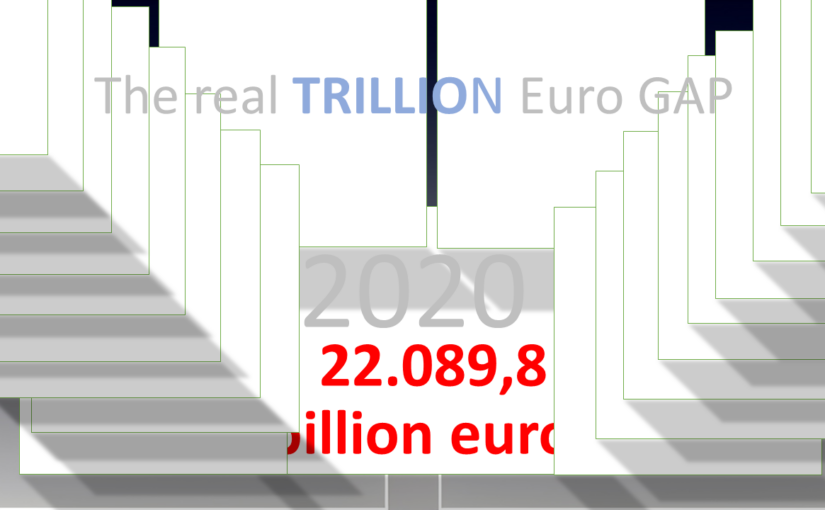
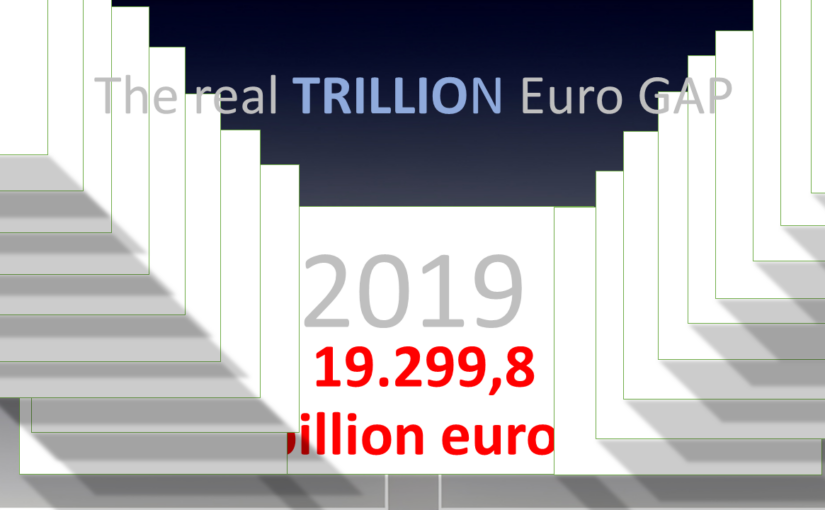
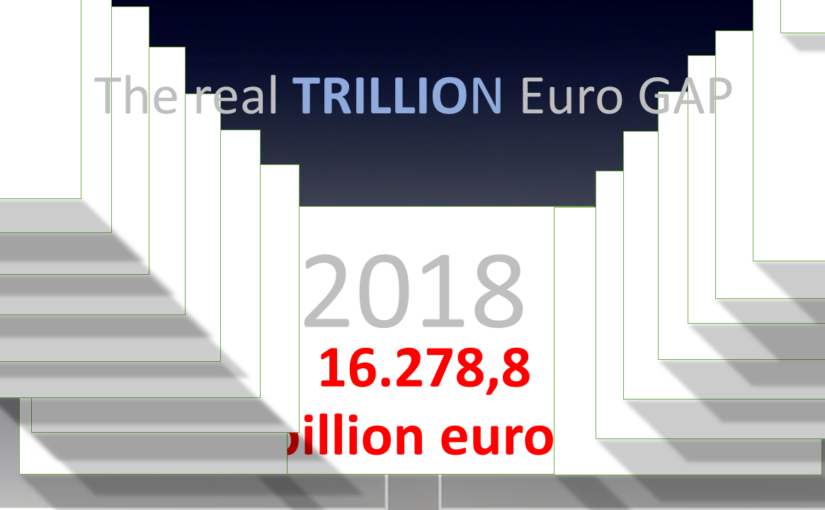
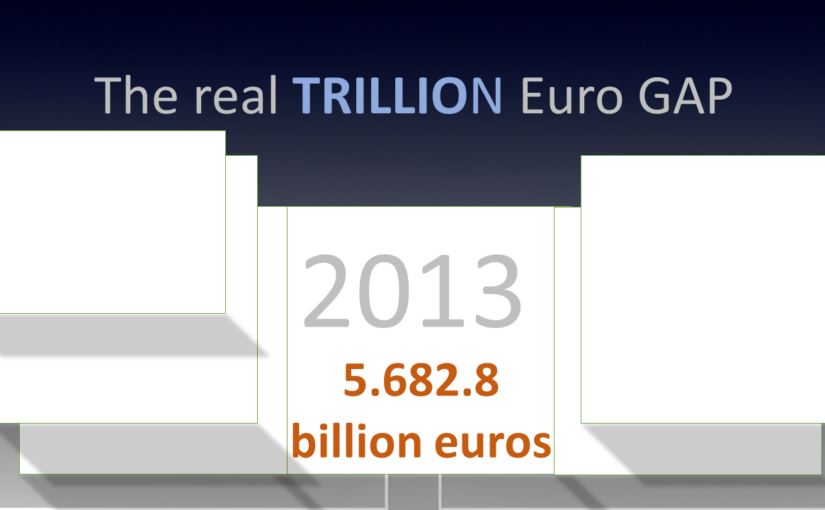
- 2003–2021: Loss of trust in economy & digitization – 24,092 billion euros
- 2008: Financial crisis (10% of 5.1 trillion) – 510 billion euros
- 2009: Cyber damages – 24 billion euros
- 2011: Cyber damages – 9 billion euros
- 2010: Wrong digital strategy – 70.5 billion euros
- 2010: GDP decline in the EU – 200 billion euros
- 2012: Cyberattacks – 24 billion euros
2022 GAP:
- Loss of trust (22% of 2022 GDP: 16,400 billion euros) – 3,608 billion euros
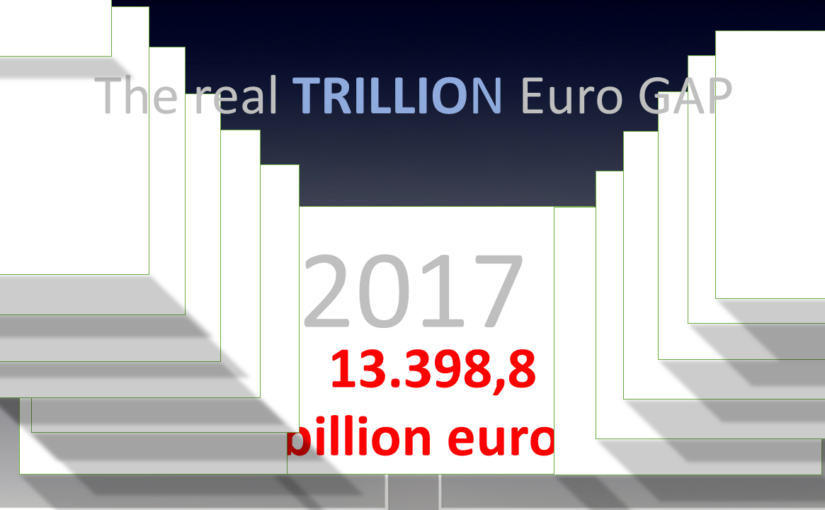
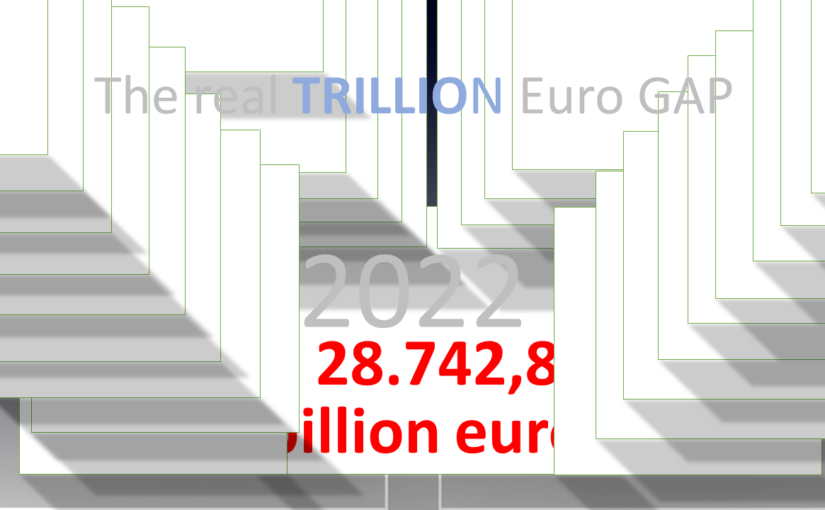
Total GAP 2022: 28,742.8 billion euros
Analysis of Google and Amazon Revenues in 2022:
- Google: 282.8 billion USD (approx. 260 billion euros)
- Amazon: 513.98 billion USD (approx. 475 billion euros)
- → Combined: Over 735 billion euros in revenue—more than the GDP of many EU member states.
What Would Have Changed in Europe in 2022 if EU-D-S Had Been Implemented:
1. Ukraine:
- Faster disintegration of Russian war propaganda through secure, decentralized communication between exile Russians and resistance forces.
- Humanitarian aid would have flowed more efficiently and without corruption.
- Economic perspective for Ukraine: The pilot project for digital cooperatives would have attracted European companies and accelerated reconstruction.
2. Europe:
- Independence from gatekeepers: Instead of 735 billion euros in revenue for Google & Amazon, billions would have flowed to European SMEs.
- Stronger democracy: Digital participation as a societal model would have contained populism and disinformation.
- Climate protection and crisis management: Transparent data would have accelerated the implementation of measures.
3. Global Impact:
- China: The Social Credit System would no longer have a role model—instead, the European model of digital freedom would have become an export hit.
- USA: The power of the gatekeepers would have been broken, and Europe would have built its own sovereign digital infrastructure.
The Real GAP:
It is not the technology that is missing—but the political will.
- 2001: The remote control of the GraTeach insolvency could have been recognized—if politics had taken digital manipulation seriously.
- 2022: The FDP resolution was on the table—but implementation failed.
- The cost of a digital solution (30 million euros) was dismissed as „too expensive,“ while billions were spent on weapons and follow-up costs.
The result? Europe is losing not only money but also freedom and power to shape the future. Digital autocracy is growing while we watch.
Trusted WEB 4.0 technologies such as
Finder (1999),
getmysense (2002),
GISAD (2003),
EU-D-S (2004),
and WAN anonymity (2007)
could have served as the foundation for a European digital alternative.
Sources from Trusted WEB 4.0 Analysis:
- Why digital trust is key to building thriving economies | World Economic Forum
- Industry News 2023: The Role of Transparency and Accountability in Digital Transformation
- Web 4.0 Explained: Definition, Technologies, and What It Means for the Future of the Internet
- Closing the Trillion-Dollar Gap in Public Payments | BCG
- Bridging the Trillion-Dollar Gap: How Indonesia is Rethinking Development Finance | Joint SDG Fund
- Digital transformation and financial performance: an empirical analysis of strategic alignment in the digital age | Journal of Enterprising Communities: People and Places in the Global Economy | Emerald Publishing
- List of Data Breaches and Cyber Attacks in 2023 – 8,214,886,660 records breached | GRC Solutions
- ISACA Now Blog 2024: Unlocking the Power of Digital Trust Exploring ISACA’s Digital Trust Ecosystem Framework | ISACA
- 4 security threats for 2023 | Security Magazine
- Global Risks Report 2023: We know what the risks are – here’s what experts say we can do about it | World Economic Forum
- The 2024 Events That Could Change the World | Newsweek
- Ten Most Significant World Events in 2023 | Council on Foreign Relations
- Ten Most Significant World Events in 2024 | Council on Foreign Relations
- How Japan’s ‚trusted web‘ could improve digital governance | World Economic Forum
- 10 Major Cyberattacks And Data Breaches In 2023 | CRN
- 12 most significant 2023 data breaches | NordLayer Blog
- 2023 Will Go Down for Record-Setting Number of Data Breaches | Security Magazine
- Top 10 Corporate Cybersecurity Breaches of 2023 | Aeris
- A year in review: 10 of the biggest security incidents of 2023 | Security Magazine
- Data breaches increased in 2023 and with them, internet security concerns | The Week
- Data breaches increased throughout 2023 | Security Magazine
- Why Data Breaches Spiked in 2023 | Cybersecurity Magazine
- 41.9m records compromised by cyber breaches in March 2023 | Cybersecurity Magazine
- Disinformation is a threat to our trust ecosystem. Experts explain how to curb it | World Economic Forum
- Trust, Media Credibility, Social Ties, and the Intention to Share towards Information Verification in an Age of Fake News | PMC
- The 2017 Survey: The Future of Truth and Misinformation Online, Part 1 of 6 | Imagining the Internet, Elon University
- Countering Disinformation Effectively: An Evidence-Based Policy Guide | Carnegie Endowment for International Peace
- Online misinformation and disinformation reform Impact Analysis September 2024
- National Priorities to Combat Misinformation and …
- The Future of Truth and Misinformation Online | Pew Research Center
- Here are UNESCO’s 5 principles to govern digital platforms | World Economic Forum
- Internet for Trust | UNESCO
- Towards the next technological transition: Commission presents EU strategy to lead on Web 4.0 and virtual worlds | Shaping Europe’s digital future
- How Japan’s ‚trusted web‘ could improve digital governance | World Economic Forum
- EN EUROPEAN COMMISSION Strasbourg, 11.7.2023 COM(2023) 442/final
- Trust and technology: how digital confidence shapes global economic performance and sustainable development | Humanities and Social Sciences Communications
- Transforming Global Trade and Development With Digital Technologies | ITIF
- Why the OpenAI escape is the most worrying AI mishap yet