
1. Likely Future Scenario: The Era of Total Digital Control
Climate change? Irrelevant – Profit is what matters
“The Earth is burning? Then we’ll sell fire extinguishers.”
- Climate protection as a marketing gimmick: Greenwashing has become state doctrine. CO₂ certificates have become speculative assets – those who can afford them buy a green conscience while emissions continue to rise.
- Climate consequences as a business model: Droughts, floods, and heatwaves are monetized:
- Water is controlled by corporations (‚premium drinking water subscriptions‘).
- Climate refugees are used as cheap labor in mega data centers.
- Unlimited energy hunger: The electricity demand from AI, surveillance, and digital entertainment is growing exponentially – powered by coal, gas, and cheap nuclear power.
Total Surveillance:
“Big Brother was just the beginning.”
- Ubiquitous sensors: Every step, glance, and conversation is recorded in real time (facial recognition, wearables, EEG sensors).
- Compliance Score: Dynamic evaluation of purchasing behavior, social contacts, and even dreams.
- Score < 80: Restricted access to public transport, healthcare.
- Score < 60: Forced labor in data centers.
- Algorithms as Judges: AI systems decide guilt and punishment – appeals are impossible.
Humans as Tools:
“Humans are the new oil.”
- Precariat 4.0: 90% of jobs are gig economy tasks, controlled by algorithms – without social security or minimum wage.
- Bodies as Commodities: Organ and data trading is thriving; health data is sold to insurance companies.
The Death of Creativity:
“Innovation is only what the algorithm allows.”
- 99% of all content is generated by AI – human artists only exist as ‚curators‘.
- Education only teaches obedience: Operating AI tools, adapting to algorithms, consumer behavior.
The New World Order:
“Tech corporations are the new kings.”
- Three mega-corporations control 90% of global infrastructure.
- Currency: Data and attention (e.g., ‚1 hour of brain scans = 1 meal‘).
2. Development Without Obstruction Using Trusted WEB 4.0
Conservative estimate: Over 50% energy savings in AI data centers while preserving pre-digital achievements.
1. Technical Savings: Decentralized AI by Category
| Current Status (Google, Meta) | Finder System | Savings |
|---|---|---|
| Central data centers with global indexing, 80% computing power for advertising/tracking | Decentralized AI per category, only relevant data is processed | 40–60% less computing effort |
2. User Behavior: Direct Connection Between Providers and Consumers
- No artificial agitation from algorithms → 30–40% less data traffic.
- Quality over quantity: getmySense evaluators filter useless content → 10–20% fewer clicks.
3. Reduced Surveillance Through Participation
- No tracking needed → 40–50% less computing effort for data analysis.
- Decentralized storage → 20–30% less server load.
4. Comparison: Energy Consumption
| Factor | Current | Trusted WEB 4.0 | Savings |
|---|---|---|---|
| Computing effort per search | 10 server requests | 2–3 server requests | 70% |
| Data traffic | High (tracking, advertising) | Low (only relevant data) | 30–40% |
| Surveillance | 30% of computing power | <10% | 40–50% |
| Total | 100% | 40–50% | 50–60% |
3. Future Perspective (2026): Promoting Individuality is Climate Protection – The Liberal Idea
Example Calculation for Europe (2026):
- Current electricity consumption of all data centers: ~200 TWh/year.
- Savings potential through Trusted WEB 4.0: 100 TWh/year (50%).
- Cost savings (€0.10/kWh): €10 billion/year.
- CO₂ savings: 30 megatons CO₂/year (equivalent to 15 million cars).
Europe’s liberals have always known: Freedom and individuality are not obstacles but the foundation for a livable and sustainable society. Now they must become the new environmental party. Because only a digital concept that strengthens our individuality can still provide a livable foundation for as many people as possible – and is simultaneously active climate protection.
Trusted WEB 4.0 as a Liberal-Ecological Solution:
- Everyone finds their place: Whether worker or intellectual – through digital participation, every person can contribute their strengths and be fairly evaluated. The system rewards performance and creativity, not conformity.
- No Fear of AI: The further development of AI does not need to be feared in Europe. On the contrary: Trusted WEB 4.0 makes AI a tool for people – not their ruler. Algorithms serve efficiency, not control.
- Gatekeepers lose their power: In the future, they will simply lack the human resources. When people work in a decentralized, participatory digital union, they no longer need intermediaries who exploit their data and restrict their freedom.
- Sustainable Investments: Every investor should ask themselves: “Where can I invest my money more sustainably – and thus more profitably in the long term?”
- Trusted WEB 4.0 offers a business model that saves energy, strengthens democracy, and keeps value creation in Europe.
- The return does not come from exploitation, but from scaling freedom and efficiency.
Long-term Benefits for Europe:
- Strengthening Europe and its sovereignty: Through digital independence from US platforms and autocratic systems.
- Pushing back autocratic systems: Democratic digital systems are more attractive than surveillance states – if they work.
- Climate protection through efficiency: Less energy consumption in data centers, less CO₂ emissions, less resource waste.
- Social Balance: Digital participation prevents poverty through exclusion. Everyone can participate – and is fairly compensated.
The Liberal Vision:
A society in which technology serves people – not the other way around. In which freedom and sustainability are not opposites. In which Europe takes on a leadership role again, not as a supplicant. Trusted WEB 4.0 is the key to this. It is time for liberals to seize this opportunity – for the economy, for the environment, and for the people.
4. GAP 2025: Climate Protection is Human Protection
Carry-over from previous years:
- 2000: Mannesmann takeover – €133 billion (loss of European sovereignty)
- 2001–2007: Unemployment due to GraTeach blockade – €18 billion
- 2004–2006: Revenue losses due to US platforms – €54.3 billion
- 2003–2024: Loss of trust in economy & digitalization – €35,645 billion
- 2008: Financial crisis (10% of €5.1 trillion) – €510 billion
- 2009: Cyber damages – €24 billion
- 2011: Cyber damages – €9 billion
- 2010: Wrong digital strategy – €70.5 billion
- 2010: GDP decline in the EU – €200 billion
- 2011: Cyber damages – €9 billion
- 2012: Cyber attacks – €24 billion
GAP 2025:
- Loss of trust (25% of 2025 GDP: €17.5 trillion) – €4.375 trillion
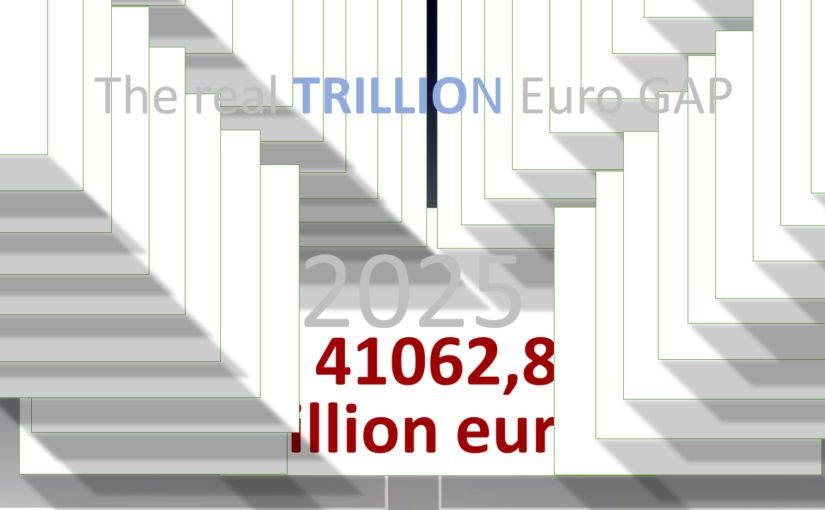
Total GAP 2025: €41,062.8 trillion
Trusted WEB 4.0 technologies such as
Finder (1999),
getmysense (2002),
GISAD (2003),
EU-D-S (2004)
and WAN anonymity (2007)
could have served as the foundation for a European digital alternative.
Notes on Understanding the GAP and the Trusted WEB 4.0 Bonus
For the years 2003 to 2026, I estimated an annual loss of trust in the economy and in digitalization. For the years 2027 to 2030, I awarded a Trusted WEB 4.0 Bonus. You can find the individual years via the search https://finders.de/?s=, followed by the year – for example https://finders.de/?s=2003 for the year 2003.
Even though the GISAD studies (available from 2027 onward) draw on the most valid figures possible for the forecasts of the future, this is not possible with precision, neither for the GAP nor for the Trusted WEB 4.0 Bonus. 9/11 caused the United States to focus on the surveillance industry, thereby influencing global societal development for decades after 2001. Nobody dares to quantify the damage caused by a single year of detrimental development for the emergence of a digital society over the next 100 years. However, an estimate is necessary so that politicians understand the impact their lack of a proactive digital strategy will have on the economy and society in the future.
Even 10 percent of the European GDP is not far-fetched in my view, since the economy too depends primarily on psychological factors. If, from 2027 onward, the EU-D-S succeeds in counteracting the feeling shared by many people that autocracies may perhaps do it even better, with the hope of an emerging genuine digital society, then the impact expressed in a Trusted WEB 4.0 Bonus for the next 100 years can hardly be valued highly enough. From 2031 onward, I refrained from further estimates because the variables had become too numerous even for an estimate.