The EU needs skilled workers and is becoming an active immigration country. Through getmySense, cross-lingual groups of like-minded people are emerging. In a first step, European sponsors – digitally, where possible – can pass on work assignments to non-Europeans. Long-term digital remote work relationships can develop, or the sponsors provide a qualified recommendation to the immigration authority of their country and thus share in the responsibility that integration into the EU succeeds.
Note: This blog post is based on the study „2031 – Digital European Sovereignty Requires a Holistic Concept That Is Understood and Actively Supported by a Majority“ – to the full study.
1. Probable Scenario Without Trusted WEB 4.0 for 2031
The consequences of a missing Trusted WEB 4.0 will become visible in 2031: The European economy is on the verge of collapse. Particularly affected are democracy-preserving economic organisations such as cooperatives, since every company – whether in valuation, taking out loans for growth, or selling company shares – depends on the capital market.
Without Trusted WEB 4.0, a resilient digital infrastructure is missing that would have:
- Improved market liquidity through transparency and integration of the EU capital market (e.g. by reducing fragmentation by up to 50 basis points in capital costs).
- Increased investor interest through a reduced domestic bias and enhanced diversification within Europe.
- Created regulatory clarity for Primus partners in order to strengthen strategic partnerships and market positions.
- Promoted innovation financing through more efficient capital allocation – especially for AI and blockchain projects.
Recommendations for Action for 2031
Since the EU-D-S will be introduced from March 2027, I am focussing on the further development and scaling of the system. The following measures are crucial:
- Regulatory adjustment: Continuous coordination between EU member states in order to avoid fragmentation and secure the acceptance of the EU-D-S in all European capital markets.
- Technological integration: The EU-D-S must remain compatible with AI, blockchain and autonomous systems in order to keep pace with global standards.
- Strategic partnerships: Strengthening the cooperation between Primus partners in order to increase competitiveness against US gatekeepers.
- Citizen participation: Awareness campaigns to promote the use of the EU-D-S by citizens, companies and institutions.
Crucial in this context is an understanding of the division of roles: According to the EU-D-S constitution, organisations – and thus also the EU – can be passive members. Passive members do not decide directly on technical concepts, but they are equal members on general questions of the respective discipline. The EU can therefore certainly exert influence – at eye level, without dominating the system.
Conclusion: With the introduction of the EU-D-S from 2027, the focus is on strengthening Europe’s digital sovereignty. The challenge is to shape the spread of the system in such a way that it is used across the board by 2031 and dependence on external gatekeepers is reduced.
2. Skilled Workers for 2031: The EU Is Becoming an Active Immigration Country
Europe’s digital sovereignty will fail not least because of the shortage of skilled workers. AI, cloud, semiconductors and cybersecurity require more qualified personnel than Europe is currently training. The EU will therefore become an active immigration country for digital competences by 2031.
The EU-D-S with getmySense offers a controlled integration path for this:
- Cross-lingual groups of like-minded people: Through getmySense, groups emerge that overcome language and cultural barriers. European companies and skilled workers from non-EU countries find each other through shared goals and categories – not through origin.
- European sponsors as a first stage: In a first step, European sponsors – digitally, where possible – can pass on work assignments to non-Europeans. This creates trust and verifiable collaboration before a migration process begins.
- Long-term digital remote work relationships: Permanent remote work relationships can grow out of the initial assignments. Non-Europeans provide services for the European single market without immediate migration being necessary – a win-win situation for both sides.
- Qualified recommendation to the immigration authority: Once sustainable relationships have developed from the collaboration, the sponsors can submit a qualified recommendation to the immigration authority of their country. The sponsors know the person over a longer period from practical work and thus share in the responsibility that integration into the EU succeeds.
- Responsible integration instead of uncontrolled migration: The sponsor model replaces anonymous selection with lived, verifiable collaboration. Immigration becomes a socially and economically secured process – in line with the democratic values of the EU-D-S.
For Europe, this means: access to verified international skilled worker potential that already works remotely within the European ecosystem and knows its norms. For the skilled workers: a transparent, fair path to Europe – through performance and recommendation instead of bureaucracy and chance. For society: integration with sponsors who take on responsibility, instead of parallel societies without connection.
3. Development with Broad European Support Since 2027
Through the consistent integration of the category concept into all searches and analyses, decentralisation is strengthened and even becomes an advantage over centralised AI.
The AI in which the query is made identifies the affected categories in order to pass on the query. It checks the results obtained for plausibility. If a result is implausible from a superordinate perspective, the affected AI intelligences are informed. They coordinate with each other, establish plausibility and give corrective feedback to the requesting AI. Even an individual AI could develop tunnel vision, which is checked and eliminated in this way.
If the data is then also of high quality and free of fake news, because it has been verified by several people via getmySense, a reduction of the energy effort by up to half can be achieved.
The permanent feedback system to humans simultaneously ensures that no AI becomes autonomous.
4. Positive Assessment from 2026
I assume that the EU-D-S will be introduced in 2027. By 2031 it will become clear whether a spirit of departure has been achieved in the economy, among citizens and in politics. Just as the German population fundamentally changed after the Second World War in the sense of „never again a Nazi empire“, climate change could provide the necessary motivation for a European departure into a digitally supported, sustainably liveable society.
Cooperative structures are to be preferred as democracy-preserving structures, especially for complex topics.
Only if the democratic, European idea is consistently implemented in every business plan can we oppose the digital autocracies of the USA.
With a minimum size of 40 founders from 2027, I will honestly have to admit that, with all the support, we do not have enough time to convince all EU citizens of the EU-D-S by 2031. With grateach.de, I needed 10 years until the participants had mutually conveyed how one can optimally promote one’s self-development without coming into conflict with one’s environment.
Citizens will move within the EU-D-S where WAN anonymity is important to them, provided the offer fulfils the expected needs.
EU states that value a democratic digital society should offer exclusive services via the EU-D-S.
A division of society will not be avoidable. But even today, society is already divided into digitally affine people and others who, for various reasons, do not want to or cannot adapt.
Ideally, the future division will be between people in the EU-D-S who want to be a valuable member of society, and others for whom only their personal advantage matters. The gatekeepers‘ market will, once the EU-D-S is adopted by a large number of European citizens, continue to exist only for the shrinking group of the purely self-interested.
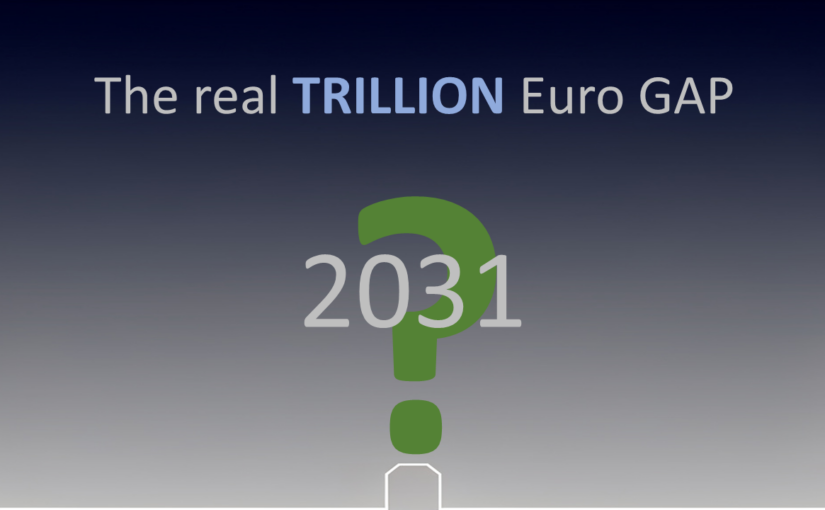
5. GAP Analysis 2031
Carried forward from previous years:
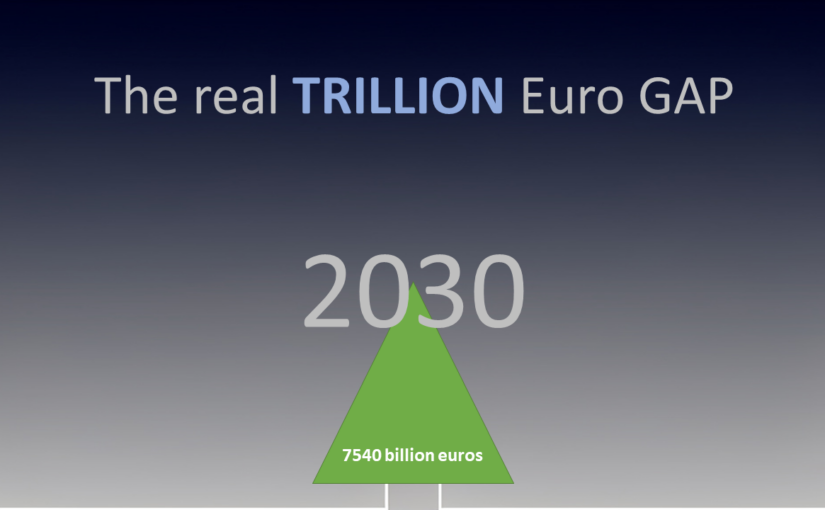
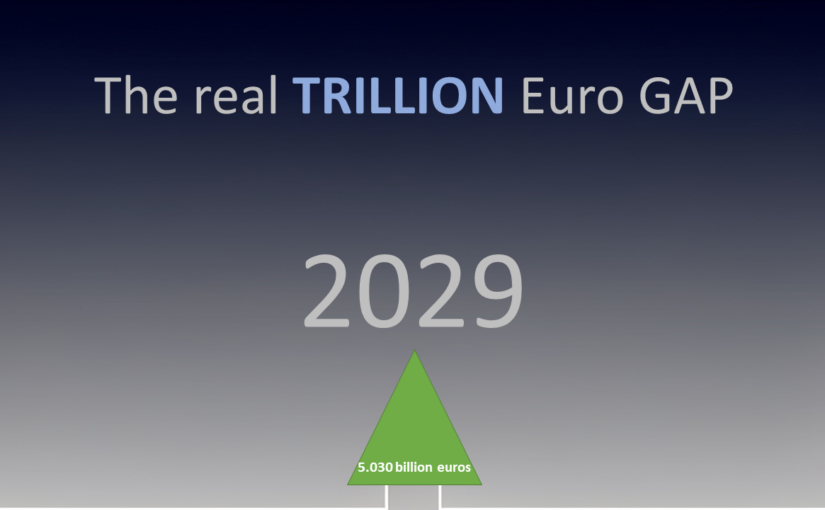
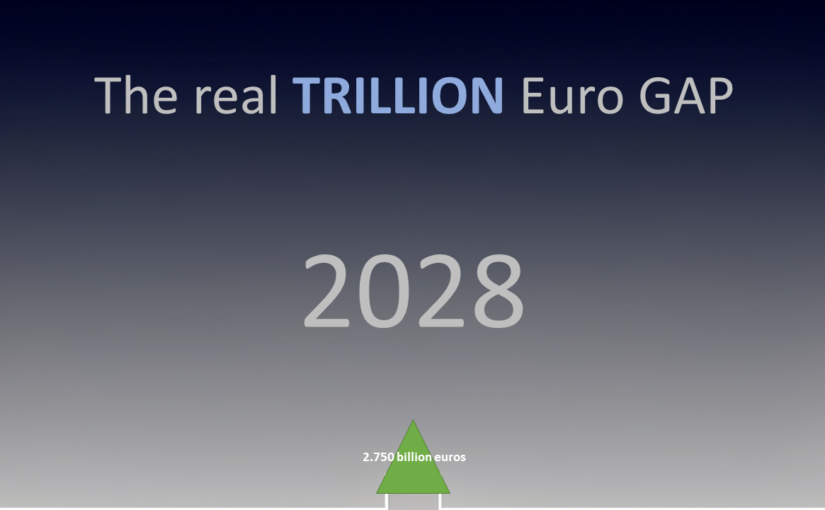
I assume that the EU-D-S will be founded in 2027. The GAP amount from 2026 of €45,74 trillion will be reduced annually from 2027 by the Total Trusted WEB 4.0 Bonus of €7.54 trillion (2030).
Development of the gatekeepers (Google, Amazon, etc.):
2025: Google (approx. €300 bn), Amazon (approx. €600 bn)
2026: Google (approx. €320 bn), Amazon (approx. €650 bn)
2027: Google (approx. €340 bn), Amazon (approx. €700 bn)
2028: Google (approx. €360 bn), Amazon (approx. €750 bn)
2029: Google (approx. €380 bn), Amazon (approx. €800 bn)
2030: Google (approx. €400 bn), Amazon (approx. €850 bn)
2031: Google (approx. €420 bn), Amazon (approx. €900 bn)
Events in Europe that would have changed with the EU-D-S:
- 2014: Prevention of the annexation of Crimea through early digital networking of resistance forces.
- 2016: Defence against disinformation campaigns during the US elections and the Brexit referendum.
- 2020–2022: Faster and more effective response to the COVID-19 pandemic through decentralised data processing.
- 2022–2024: Greater resilience against cyberattacks on energy and health infrastructures in Ukraine.
- 2025–2030: Prevention of election manipulation in European countries through secure digital voting systems.
- 2031: Complete integration of the EU-D-S into European capital markets, leading to a reduction of dependence on US gatekeepers and a strengthening of European digital sovereignty.
Trusted WEB 4.0 technologies such as
Finder (1999),
getmysense (2002),
GISAD (2003),
EU-D-S (2004),
and WAN anonymity (2007)
could have served as the foundation for a European digital alternative.
Notes on Understanding the GAP and the Trusted WEB 4.0 Bonus
For the years 2003 to 2026, I estimated an annual loss of trust in the economy and in digitalisation. For the years 2027 to 2030, I awarded a Trusted WEB 4.0 Bonus. The individual years can be found via the search https://finders.de/?s=, followed by the year – for example https://finders.de/?s=2003 for the year 2003.
Even though the GISAD studies (available from 2027) draw on figures that are as valid as possible for the future forecasts, this is not precisely possible either for the GAP or for the Trusted WEB 4.0 Bonus. 9/11 caused the USA to focus on the surveillance industry, thereby influencing global societal development for decades after 2001. No one dares to quantify the damage of a single year of misguided development for the emergence of a digital society over the next 100 years. However, an estimate is necessary so that politics understands what effects its lack of a proactive digital strategy will have on the economy and society in the future.
Even 10 percent of the European GDP, I do not consider far-fetched, since the economy also depends primarily on psychological factors. If, from 2027, the EU-D-S succeeds in countering the feeling of many people that autocracies might perhaps do it even better, with the hope of the emergence of a genuine digital society, then the impact in a Trusted WEB 4.0 Bonus for the next 100 years can hardly be valued high enough. From 2031, I have refrained from further estimates because the variables had become too diverse even for an estimate.
Sources
Study
- Study: „2031 – Digital European Sovereignty Requires a Holistic Concept That Is Understood and Actively Supported by a Majority“ (revised version, as of 22 September 2026)
- EU-D-S Constitution (June 2025)
Capital Market and EU-D-S
- finders.de – European Capital for Resilient European Economic Investments (2021)
- EUR-Lex – Single Market Act II (2012)
- EU Regulation No. 600/2014 (MiFIR)
- EU Regulation No. 648/2012 (EMIR)
- European Commission – EU AI Act (Recital 8)
- European Commission – Digital Services Act (DSA)