
The study „Outsourcing of Social Costs to the EU-D-S“ analyzes in detail how EU member states can relieve their social systems. It will appear in about 2 weeks.
1. Likely Scenario Without Trusted WEB for the Future
Forecast for 2029: General costs will rise by 15–25% due to:
- Destruction of fossil reserves: Due to the Iran and Ukraine wars, 30–40% of Europe’s oil and gas imports are no longer available. The EIA forecasts a rise in Brent crude oil prices to over 80 USD/barrel by the end of 2024 (EIA, 2024). Import costs will increase by €200–300 billion/year.
- Limited transport options: Due to low water levels on rivers (e.g., Rhine: –60% freight capacity in summer 2028, Tagesschau, 2023) and blocked trade routes, logistics costs will rise by 20–30%.
- Climate costs: The EU already spends €300–400 billion/year (2–3% of GDP) on climate protection measures. By 2029, these costs will rise to €500–600 billion/year as extreme weather events (heatwaves, floods) strain infrastructure (DIW Berlin, 2025).
- Demographic strain: Despite rising life expectancy (+2.5 years since 2020), there is no additional budget for pensions. The pension gap amounts to €300–500 billion/year (Euronews, 2026).
- Decline in tax revenue: The traditional industry (e.g., automotive) loses 10–15% revenue per year. Tax revenue will fall by €150–200 billion/year (Tagesschau, 2024).
Conclusion: Without Trusted WEB 4.0, the EU faces a cumulative cost explosion of €1,000–1,500 billion/year by 2029—amid declining revenue and growing social inequality.
2. Development with Broad European Support for Trusted WEB 4.0
Following the first successful Primus companies in the EU-D-S (2027–2028), it is clear: Trusted WEB 4.0 enables sustainable value creation and digital participation. If a spirit of optimism spreads among citizens and businesses, states can outsource participation issues to the EU-D-S—while simultaneously relieving their budgets.
Transferring pre-digital principles into digitization means:
- Individual and flexible design: Digitization and AI enable personalized solutions—without the rigid structures of analog systems.
- Participation payments instead of social costs: The state can replace 20–30% of social costs (approx. €500–700 billion/year) through digital participation in the EU-D-S. This relieves budgets and strengthens personal responsibility.
- Win-win for high achievers: Companies pay less tax but receive high-quality data and more efficient processes through getmySense.
A purely AI-driven economy that views people solely as data providers and consumers benefits most people little. Trusted WEB 4.0 focuses on genuine participation and fair value creation.
Performance principle as a foundation:
- getmySense for students: Even in school, young people can test in various categories whether they can achieve performance levels 1–10—without negative evaluations. The risk: An AI classifies them into a different level.
- Flexible participation: Everyone can decide for themselves how many hours per month they want to contribute or create evaluations. Billing is done automatically via micropayments, depending on the value of the contribution.
- No age limits: Everyone can participate in any age-appropriate category. Behind the WAN-anonymous keys, a year of birth can be stored for age controls regarding content harmful to minors.
- AI-supported quality control: Example: A non-medical professional explains simple medical contexts in performance level 1 for other non-medical professionals. The AI checks whether this aligns with performance level 10 (medical expertise) and, if necessary, requests adjustments.
New financing models:
- Unit price-based contract awarding: Instead of complicated funding rules, the state awards contracts at fixed unit prices for defined services. No dependence on changing government majorities.
- Involvement of educational institutions: Schools and universities can be integrated into the data economy.
- „Digital Year“: A 3–24-month interdisciplinary scholarship (modeled after GraTeach), refinanced by companies: approx. €1,000 per month per participant. The state gets the money back if graduates remain with the company for 24 months.
- Self-sustaining teachers: After an initial phase, teachers finance themselves through project output—as would have been possible with GraTeach if the public sector had paid market-based prices for contracts.
3. 2026 Forecast of Impacts – Participation as the DNA of Digital Democracies
Participation is becoming the DNA of emerging digital democracies. The economic potential of Trusted WEB 4.0 is best demonstrated by the scientifically proven consequences when people are excluded from societal participation due to poverty, illness, or age (WHO, 2024).
Health Consequences
| Area | Facts (EU/D, 2029) | Costs/Consequences |
|---|---|---|
| Physical Health |
|
€150–200 billion/year in additional healthcare system costs (Umweltbundesamt, 2023). |
| Mental Health |
|
€100–150 billion/year in productivity losses (Süddeutsche Zeitung, 2023). |
Social Consequences
| Area | Facts (EU/D, 2029) | Costs/Consequences |
|---|---|---|
| Social Exclusion |
|
€50–100 billion/year in social follow-up costs. |
| Economic Consequences |
|
€200–300 billion/year due to lower tax revenue and higher social spending. |
| Social Cohesion |
|
€100–200 billion/year due to political instability. |
Total costs of non-participation for the EU (2029): €600–1,000 billion/year (4–7% of GDP).
Trusted WEB 4.0 can reduce these costs by 30–50% through:
- Preventive healthcare (€50–100 billion savings/year)
- Active participation of the elderly (€100–150 billion additional value creation/year)
- Digital integration of migrants (€50–100 billion tax revenue/year)
- Reduced polarization (€50–100 billion through more stable democracy/year)
Trusted WEB 4.0 Bonus 2029: EU Member States Understand the Potential
Carryover from previous years:
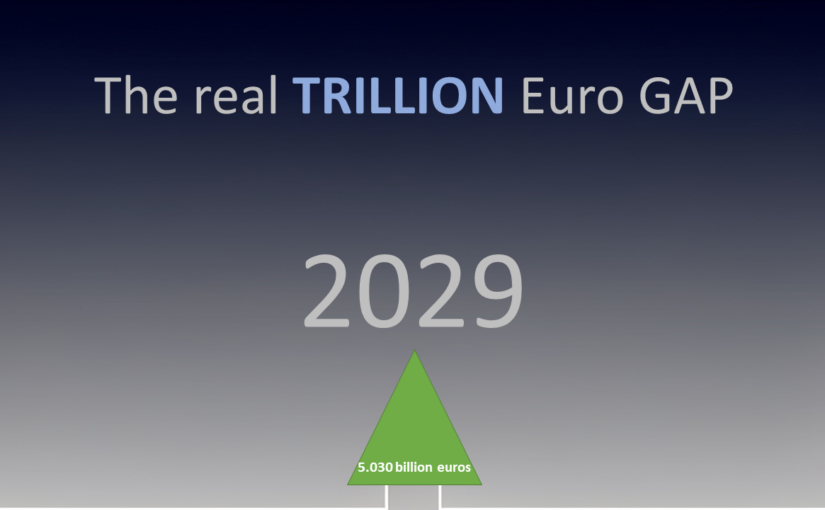
It is assumed that the EU-D-S will be founded in 2027. The GAP amount from 2026 of €45,74 trillion will be reduced annually by a Trusted WEB 4.0 Bonus starting in 2027, based on trust-building.
Trusted WEB 4.0 Bonus:
Growth is based on a spirit of optimism—which requires trust.
The Trusted WEB 4.0 Bonus for 2029 is estimated at 12% of the EU GDP for 2029. With an estimated EU GDP of approximately €19.0 trillion (growth: +3% p.a. since 2026), the bonus would amount to €2.28 trillion. This bonus would reduce the GAP amount by this value.
- Trusted WEB 4.0 Bonus 2027: €900 billion (5% of EU GDP 2027: €18.0 trillion)
- Trusted WEB 4.0 Bonus 2028: €1.85 trillion (10% of EU GDP 2028: €18.5 trillion)
- Trusted WEB 4.0 Bonus 2029: €2.28 trillion (12% of EU GDP 2029: €19.0 trillion)
Total Trusted WEB 4.0 Bonus: €5.03 trillion
Trusted WEB 4.0 technologies such as
Finder (1999),
getmysense (2002),
GISAD (2003),
EU-D-S (2004),
and WAN anonymity (2007)
could have served as the foundation for a European digital alternative.
Notes on Understanding the GAP and the Trusted WEB 4.0 Bonus
For the years 2003 to 2026, I estimated an annual loss of trust in the economy and in digitalization. For the years 2027 to 2030, I awarded a Trusted WEB 4.0 Bonus. You can find the individual years via the search https://finders.de/?s=, followed by the year – for example https://finders.de/?s=2003 for the year 2003.
Even though the GISAD studies (available from 2027 onward) draw on the most valid figures possible for the forecasts of the future, this is not possible with precision, neither for the GAP nor for the Trusted WEB 4.0 Bonus. 9/11 caused the United States to focus on the surveillance industry, thereby influencing global societal development for decades after 2001. Nobody dares to quantify the damage caused by a single year of detrimental development for the emergence of a digital society over the next 100 years. However, an estimate is necessary so that politicians understand the impact their lack of a proactive digital strategy will have on the economy and society in the future.
Even 10 percent of the European GDP is not far-fetched in my view, since the economy too depends primarily on psychological factors. If, from 2027 onward, the EU-D-S succeeds in counteracting the feeling shared by many people that autocracies may perhaps do it even better, with the hope of an emerging genuine digital society, then the impact expressed in a Trusted WEB 4.0 Bonus for the next 100 years can hardly be valued highly enough. From 2031 onward, I refrained from further estimates because the variables had become too numerous even for an estimate.
Sources
Energy and Transport
- EIA: Oil Market Report 2024 – Forecasts for oil and gas prices (Brent crude oil price over 80 USD/barrel)
- Tagesschau: Impact of low water levels on the Rhine (–60% freight capacity in summer 2028)
- Abendblatt: Low water levels in Rhine, Elbe, and Danube – Inland navigation struggles with consequences
- VDI: Low water levels impair inland navigation
- VerkehrsRundschau: Inland vessels with less cargo due to low water levels
Climate Costs and Pension Gap
- DIW Berlin: Two Decades of Climate Cost Research – Preventive Climate Protection as an Economic Advantage (€300–400 billion/year)
- Umweltbundesamt: Societal Costs of Environmental Pollution
- Süddeutsche Zeitung: Energy Transition – Does Expensive Climate Protection Pay Off?
- Euronews: Europe – Wage and Pension Gap (€300–500 billion/year)
- Deutsche Sozialversicherung Europavertretung: Pensions at a Glance
- VZ VermögensZentrum: Pension Increase 2026
- DW: Europe Struggles with the Future of Pensions
Automotive Industry
- Tagesschau: Automotive Summit – Europe’s car manufacturers face „unprecedented challenge“ (–10–15% revenue/year)
- European Newsroom: Automotive Industry on Life Support – EU Calls Strategic Talks
- Merkur: Study Warns of Decline in Europe’s Automotive Industry – Severe Losses by 2030
Health and Social Consequences
- WHO: European Health Report 2024 – Keeping Health High on the Agenda
- Armut und Gesundheit: Current Data on the Relationship Between Poverty and Health (5–10 years difference in life expectancy)
- Deutsches Ärzteblatt: Poverty and Health – Social Dimension of Disease Neglected (40% more frequent infectious diseases)
- Sozialministerium Baden-Württemberg: Social Isolation and Loneliness of People at Risk of Poverty (2–3× more frequent depression)
- Assmann-Stiftung: Social Isolation and Loneliness Linked to Premature Death (50% higher dementia risk, doubled mortality risk)
Social Exclusion and Homelessness
- Hans-Böckler-Stiftung: Social Inequality in Germany (20–30% of the poor socially isolated, –40% political participation)
- Bundesregierung: Homelessness Report 2024 (1–2% of the population homeless, 90% urgently in need of treatment)
- Österreichisches Sozialministerium: Data Basis on Homelessness
- Neunerhaus: Regression Instead of Progress – Homelessness in Austria Continues to Rise
Economic Consequences and Poverty
- Paritätischer Wohlfahrtsverband: Poverty Report 2025 (15–20% of households in poverty for >5 years)
- IW Köln: Poverty – Institute of the German Economy (19 million children in the EU disadvantaged, 22%)
- Bertelsmann Stiftung: Consequences of Poverty for Children and Adolescents (3× higher risk of remaining in poverty)
Social Cohesion and Trust
- Präventionstag: Loss of Trust in Political Institutions (60% of citizens)
- EDJNet: From Low Trust in Institutions to the Rise of the „Critical Citizen“ (+25% polarization since 2020)
- Statista: Trust in Political Parties in Germany (20–25% of votes for anti-establishment parties)
- Österreichische Gesellschaft für Europapolitik: The Trust Deficit in the EU Periphery