
1. Real Situation in 2013: Surveillance as a Tool of Power
I had already written my second book, „The Trillion Dollar Gap“. In an excerpt from the fictional story „QX – Island in Jezioro Kisajno“, I wrote: „The Quadrilla is to decide who should be promoted or eliminated.“ With this, I wanted to show that surveillance does not serve to protect citizens but rather to exercise power in secret—without democratic legitimacy.
By 2013, the stage was already set for Europe’s later dependence on US surveillance tools like Palantir. The EU relied on centralized databases and automated analyses without sufficiently examining the risks of dependencies or their compatibility with European data protection standards. In December 2013, the Advocate General at the ECJ, Pedro Cruz Villalón, classified data retention as disproportionate and in violation of fundamental rights—a clear signal that the EU was wavering between security and fundamental rights. Yet instead of consistently upholding its values, it gave in.
2. Development Without Obstruction: AI Designed Democratically from the Outset
If I had not been forced to abandon my search engine patent from 1999 due to persecution, this technology could have actively shaped the discussion around AI and data sovereignty. The Finder algorithm uses the smallest meaningful unit, which is firmly linked to categories. This makes manipulation more difficult, as like-minded individuals from the same category automatically receive new entries for evaluation. Every AI learns from training data. The category framework trains the AI to allow different perspectives in various societal areas, thereby also training ethics. The genuine interest of evaluators in generating high-quality data significantly improves the quality of AI outputs.
The question is: Does the state want to deny its citizens digital participation? Scalable business models of gatekeepers aim only at power—not at societal added value. A productive digital activity for all must be a fundamental right. Those who are included do not boycott, are less likely to fall ill, and incur fewer social costs. Transforming social costs into participation payments would be an economic gain: High-quality data improves AI outputs and reduces frictional losses in digital transformation.
Perspective from the Future (2026): Is It Too Late?
Populists are elected because they best reflect the digital reality of fake news. They are financed by circles that see people as a mass to be manipulated. Citizens feel: The parties no longer represent their interests.
Currently, it is evident how these developments continue to progress: The state of North Rhine-Westphalia wants to consolidate its power with a new constitutional protection law. The Green Minister of Justice does not object, while the FDP is taking the matter to the Federal Constitutional Court to review its constitutionality.
Here, Trusted WEB 4.0 with a tiered system for AI-supported analyses could offer an alternative:
The entire process can be completed in minutes and does not delay the investigation.
Authorities hope to emulate the power growth of gatekeepers with Palantir. However, WAN anonymity would be more efficient: Forensic data is stored decentrally, and only in the event of damage does a judge release the absolutely relevant data. Mass surveillance destroys citizens‘ trust—and is less efficient than WAN anonymity.
Question to the EU: Has anyone compared the damages prevented by Palantir with the societal damages caused by loss of trust and perceived mass surveillance? Would the trillion-GAP estimated under point 4 also have been achieved with more digital social control and less surveillance?
—
4. GAP 2013: Edward Snowden Made the Loss of Trust Visible to All
Edward Snowden’s revelations in 2013 primarily concerned global surveillance by the NSA and its partners, particularly the mass collection of data from Europe. The direct economic damages for Europe are difficult to quantify, but the political and diplomatic consequences were severe:
Carryover from Previous Years:
- 2000: Mannesmann takeover – €133 billion (loss of European sovereignty)
- 2001–2007: Unemployment due to GraTeach blockade – €18 billion
- 2004–2006: Revenue losses due to US platforms – €54.3 billion
- 2003–2012: Loss of trust in economy & digitalization – €3,340 billion
- 2008: Financial crisis (10% of €5.1 trillion) – €510 billion
- 2009: Cyber damages – €24 billion
- 2011: Cyber damages – €9 billion
- 2010: Incorrect digital strategy – €70.5 billion
- 2010: GDP decline in the EU – €200 billion
- 2011: Cyber damages – €9 billion
- 2012: Cyberattacks – €24 billion
GAP 2013:
- Loss of trust (10% of 2013 GDP: €13 trillion) – €1,300 billion
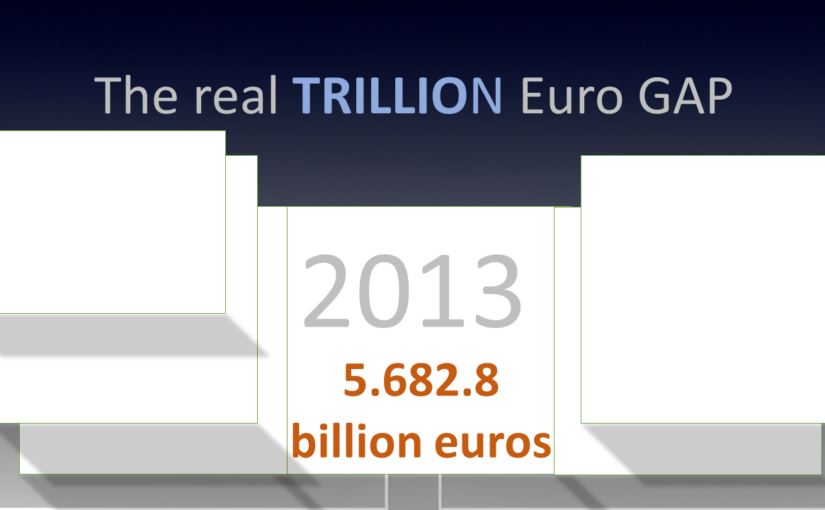
Total GAP 2013: €5,682.8 billion
Trusted WEB 4.0 technologies such as Finder (1999), getmysense (2002), GISAD (2003), EU-D-S (2004), and WAN anonymity (2007) could have served as the foundation for a European digital alternative.
- Sources on the Snowden Revelations in 2013 and Their Consequences for Europe:
Global Surveillance and Espionage Affair – Wikipedia- Süddeutsche Zeitung: Geopolitical Consequences of the Snowden Revelations
- Tagesspiegel: Cybercrime in Germany 2013
Sources on EU GDP in 2013: