
1. Real Situation in 2018: Attempt to Contribute
The fundamental challenges of digitalization were already known in 2018: Democratic prerequisites instead of mere platform opening.
The USA used the collective shock after 9/11 to position its digital economy globally. Ultimately, it is the economy that creates the foundation for a livable society. Autocracies currently benefit particularly from centralized, global digital business models—led by US gatekeepers. This leads to an increasing number of democracies developing toward autocracy, as their models appear to harmonize more efficiently with digitalization.
As the head of the Digital Democracy working group in the North Rhine-Westphalia state expert committee, I worked for the first time to support state politics. We passed unanimous resolutions that, if implemented consistently, would have set the course for democratic digitalization. However, before the resolutions could be implemented, a representative from China boycotted the constructive work so massively that I resigned from my leadership position to exclude personal conflicts. Afterward, the state expert committee was dissolved—a symbol of the blockade of democratic digitalization processes by external interests.
Linguistic Dominance as an Instrument of Power:
By 2018, Google was already able to translate in over 100 languages, while DeepL covered only 9 languages at the time. Nevertheless, English dominates as a world language—not just in the digital world, but also in global cultural production. Most Western films are first shot in English, establishing the American way of life as the global standard. This leads to:
– a displacement competition among cultures,
– a two-class society between those who speak English and those who are excluded.
Against the backdrop of the goal to include everyone in digitalization, such artificial barriers are unacceptable—especially when technical diversity is possible.
—
2. Development Without Obstruction: Trendsetter for a Convergence of the Democratic World and 2018: The GAP of Missed Inclusive Value Creation
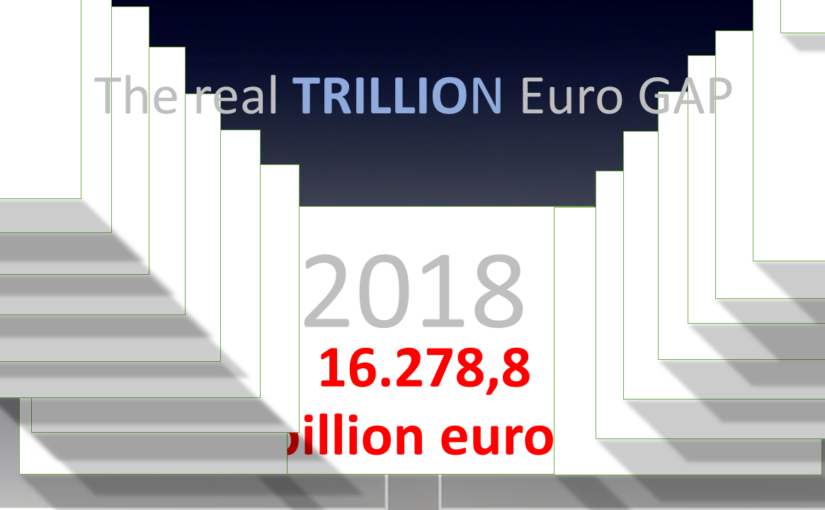
In 2018, the GAP due to the lack of inclusive digitalization amounted to €16,278.8 billion—an amount that already exceeded the EU deficit of €13,500 billion in 2026. Trusted WEB 4.0 would not only have prevented this GAP but would also have solved two central global challenges through decentralized, user-controlled value creation:
– One trillion euros for climate protection through more efficient, data-driven resource management and, as a first step, CO₂-neutral AI, including all IT systems within Trusted WEB 4.0.
– Over €1 trillion to reward social benefit recipients who actively participate in generating high-quality data—without a uniform performance standard that excludes many.
What Trusted WEB 4.0 Would Have Enabled:
– Inclusive Participation: Every person could have chosen, regardless of abilities or limitations, WAN-anonymously and without stigmatization, from 10 performance groups to generate value at their own pace and according to their capabilities.
– Peer-to-Peer Support: Many problems that today require teachers or social workers could have been resolved among the people themselves. Ordinary people often understand each other better than institutions.
– Flexible Value Creation: Instead of financing rigid systems that exclude many, Trusted WEB 4.0 would have enabled individual contributions—thus strengthening social cohesion without compromising the dignity of the individual.
Missed Opportunity:
In 2018, €140 billion in social benefits for the disabled in Europe remained a pure cost factor—even though 30–40% of this group could have participated for a few hours a day through flexible, digital work models.
If getmySense had been consistently promoted since 2002, the concept would have become known worldwide before gatekeeper products. With over 2,500 written languages in the world, the platform would have connected trendsetters from all linguistic regions:
– Users would have recorded the smallest meaningful unit (Finder) in their language on a topic.
– Units with the same meaning in different languages would have been statically linked.
– European translation programs could have developed exponentially faster, starting with high-frequency categories.
Consequences for Global Democracy:
– A natural understanding would have emerged: There are no geographic borders in the digital world.
– The European Digital Union would have emerged as a global extension of the EU for users who subject themselves to the Charter of Fundamental Rights of the European Union (see Article 9 of the EU-D-S Constitution).
– Democratic countries would have grown closer together in the areas of immigration, trade, and standards and displaced autocracies.
Technical Milestones:
– A global market for real-time audio simultaneous translation would have emerged—technically feasible as early as 2018 with in-ear headphones: An integrated microphone records foreign-language communication, translates it in real time, and plays it back via voice output.
—
3. A Look from the Future (2026): European SMEs Must Receive a Future Perspective
In 2018, 45.7% of the world’s population lived in democracies and 54.3% in autocracies or hybrid regimes. According to the current „Varieties of Democracy“ (V-Dem) report, in 2026 only 26% live in democracies, while 74% live in autocracies. Numerous studies prove a direct connection between centralized digitalization and the decline of democratic structures.
Solution Approaches Through AI and Structural Data:
Thanks to millions of training data points from the years 1999–2008, today an AI can connect the smallest meaningful units (Finder) in 2,500 languages with each other and generate translation programs from them. The new patent application 10 2026 000 788.7 supports this process. There are therefore no technical obstacles to implementing such a concept promptly.
The Central Question:
Is there still a democratically oriented economy with enough strength to come together to generate sustainable value for itself and its customers? Or are personal freedoms in an autocratic system irrelevant as long as the cash registers of large foreign companies are ringing?
Trusted WEB 4.0 as an Alternative:
The concept does not need to compete with the gatekeepers. It is sufficient to support the consistent continuation of pre-digital consumer behavior. Then consumers will come on their own—and companies will follow. The first-move principle is decisive here, which is additionally promoted in the EU-D-S.
Trust as an Economic Factor:
Current politics undermines this trust by focusing on the redistribution of non-existent budgets within the framework of its clientele—without considering that the required money has long since stopped being earned. Instead, it should use Trusted WEB 4.0 to create a sense of new beginnings.
Social Costs as an Investment:
– Transforming social benefits into future investments (participation payments) can lead to digital public wealth in the form of high-quality data.
– Whether prospective migrants or citizens excluded from society—if everyone is included in the digitalization process, there will be:
– no more demographic problems,
– no more unaffordable social costs such as pensions.
– Once the language problem in the digital world is solved, Europe will have access to the best global talents as digital workers via the Digital Union. Proven digital collaboration can lead to migration in the second step.
Security as a Cornerstone:
In European countries, people leave money on their kitchen tables—they do not expect hostile states to break into their homes and steal it. Yet this is the digital reality today: An undeclared hybrid war by autocracies is increasingly calling societal achievements into question. Without the consistent use of WAN anonymity, perpetrators remain undetected and unpunished.
4. GAP 2018: Risk Minimization Instead of Economic Expansion
Carryover from Previous Years:
- 2000: Mannesmann Takeover – €133 billion (Loss of European Sovereignty)
- 2001–2007: Unemployment due to GraTeach Blockade – €18 billion
- 2004–2006: Revenue Losses due to US Platforms – €54.3 billion
- 2003–2017: Loss of Trust in Economy & Digitalization – €12,356 billion
- 2008: Financial Crisis (10% of €5.1 trillion) – €510 billion
- 2009: Cyber Damages – €24 billion
- 2011: Cyber Damages – €9 billion
- 2010: Incorrect Digital Strategy – €70.5 billion
- 2010: GDP Decline in the EU – €200 billion
- 2012: Cyberattacks – €24 billion
GAP 2018:
- Loss of Trust (18% of 2018 GDP: €16 trillion) – €2,880 billion
Total GAP 2018: €16,278.8 Billion
Trusted WEB 4.0 technologies such as
Finder (1999),
getmysense (2002),
GISAD (2003),
EU-D-S (2004)
and WAN anonymity (2007)
could have served as the foundation for a European digital alternative.
—
Sources
- finders.de – Democratic Prerequisites for Platforms
- EU-D-S Constitution (Article 9: European Digital Union)
- Varieties of Democracy (V-Dem) Report 2026
- EU-D-S: First-Move Principle and Dynamic Monopolies
- GraTeach Blockade and Its Consequences
- Translation via Headphones
- Deutsches Ärzteblatt: Social Expenditure 2018
- VPV: Social Expenditure 2017/2018
- Süddeutsche Zeitung: Social Expenditure 2018
- WDR Monitor: Hartz IV and Disability
- Statista: Involuntary Part-Time Employment in Europe