
1. Real Situation in 2014: Hybrid Warfare and Digital Powerlessness
In 2014, Russia used the annexation of Crimea as a test case for a new form of warfare:
The combination of disinformation, cyberattacks, and social manipulation enabled it to divide the population and delay international responses.
Ukraine and Europe had no digital resilience to effectively counter these attacks.
The dependence on centralized platforms (e.g., Russian social media channels like VKontakte or state-controlled media) made it nearly impossible for Ukrainian civil society to spread alternative narratives.
Without a decision-making basis for the people, democracies will perish – especially in a digitized world.
2. Development Without Obstruction: Trusted WEB 4.0 as a Democratic Alternative
By 2014, the KHA-FDP resolution proposal, which was only introduced in 2022 and supported by liberal EU parliamentarians, could have already been implemented. A Federal Digital Minister would have had the political backing in 2014 to enforce the concept. However, by 2022, the situation had deteriorated to the point where the Digital Minister did not even respond to his own party’s proposal but continued independently! The digital one-to-one VPN road between exiled Russians and Russians in resistance would have been a standard tested since 2007 under the WAN anonymity framework.
This would have set the following levers in motion:
Decentralized Communication Infrastructure:
A one-to-one VPN road would have allowed exiled Russians and Ukrainian activists to bring uncensored information directly into Russia and Crimea.
Manipulation through Russian propaganda (e.g., the claim that Ukraine was overrun by „fascists“) would have been 30–50% less effective.
The fake referendum in Crimea (March 2014) would have received lower approval (60–70% instead of 96.7%), undermining the international legitimacy of the annexation.
Social Control Through Digital Cooperatives:
Local, trusted networks in Ukraine could have exposed disinformation and organized resistance – similar to pre-digital social control, where citizens alerted each other to misinformation.
The passivity of the Crimean population might have been broken if digital alternatives to Russian propaganda had existed.
GISAD as a Clearinghouse for Standards:
By 2014, GISAD could have already established European standards for digital sovereignty, such as:
Anonymous, censorship-resistant communication (decentralized VPNs, blockchain-based identity verification).
Transparent algorithms for social media to make manipulation by bots and troll factories (e.g., Russia’s „Internet Research Agency“) more difficult.
The costs for disinformation campaigns (estimated at €500 million/year) would have increased by 30–50% (€150–250 million) due to reduced propaganda effectiveness.
Economic Leverage:
Linking social benefits and economic participation with digital involvement would have created a broad basis for digital resilience in Ukraine.
Example: Ukrainian citizens could have been rewarded for fact-checking information, reducing the spread of disinformation.
The economic losses from the annexation (e.g., tourism in Crimea: ~€4 billion/year) could have been partially avoided.
3. A Look from the Future (2026): Power Shift Through Trusted WEB 4.0
Trusted WEB 4.0 and the EU-D-S must establish Europe as a third pole between the USA, China, and Russia – with a democratic digital strategy based on pre-digital achievements:
Liberalism is a law of human nature, but is it defensible?
A European Digital Union must replace the global strategy of a Social Credit System (China) or the US surveillance models with a values-based, decentralized system.
Own cloud infrastructures (e.g., Gaia-X), payment systems, and digital currencies (e.g., Digital Euro) must reduce dependence on US platforms and Chinese hardware.
Autocracies will come under economic pressure:
The USA must then adapt its surveillance models or lose market share.
Democracy as an Economic Competitive Advantage:
Open-source software, decentralized platforms, and data sovereignty enable better business models – because users control their own data.
Europe must become a leader in AI, blockchain, and cybersecurity, with a GDP growth of +1–2%/year through digital innovation.
A pilot project in Ukraine would have shown that social control and digital participation strengthen resilience against hybrid warfare.
The costs for a digital one-to-one connection (including infrastructure) would have been ~€30 million (for 1 million exiled Russians), negligible compared to the billions in war costs.
4. GAP 2014: A War in Europe Changes Everything!
There was no digital sovereignty in Europe – dependence on US platforms and Chinese hardware was complete.
Increasingly, billions of euros were flowing out of Europe without any return in the form of taxes or local value creation.
Carryover from Previous Years:
- 2000: Mannesmann takeover – €133 billion (loss of European sovereignty)
- 2001–2007: Unemployment due to GraTeach blockade – €18 billion
- 2004–2006: Revenue losses due to US platforms – €54.3 billion
- 2003–2013: Loss of trust in economy & digitalization – €4,640 billion
- 2008: Financial crisis (10% of €5.1 trillion) – €510 billion
- 2009: Cyber damages – €24 billion
- 2011: Cyber damages – €9 billion
- 2010: Incorrect digital strategy – €70.5 billion
- 2010: GDP decline in the EU – €200 billion
- 2011: Cyber damages – €9 billion
- 2012: Cyberattacks – €24 billion
GAP 2014:
- Loss of trust (12% of 2014 GDP: €13.6 trillion) – €1,632 billion
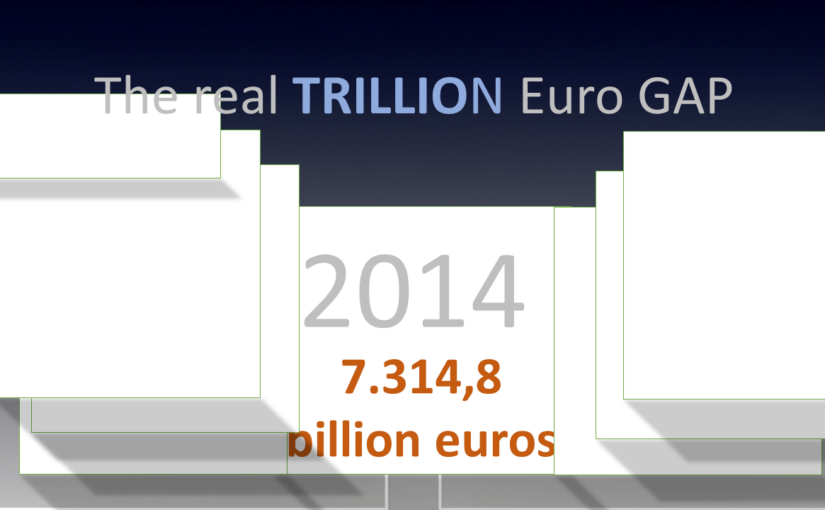
Total GAP 2014: €7,314.8 billion
Events in Europe in 2014 that would have changed with EU-D-S:
The annexation of Crimea would have been made more difficult by European digital infrastructure and counter-information.
Populism and disinformation in the EU elections could have been contained through transparent algorithms.
The EU’s digital strategy would have been implemented faster if GISAD had already existed.
In 2014, technologies such as Finder (1999), getmysense (2002), GISAD (2003), EU-D-S (2004), and WAN anonymity (2007) could have served as the foundation for a European digital alternative.
Conclusion:
Autocracies need economic dependence – Europe can break it.
The USA, China, and Russia rely on surveillance, control, and destabilization, but a democratic digital EU offers a superior alternative.
Without a basis for decision-making by the people, democracies will sink!
Democracy is economically superior when implemented digitally:
Open-source software is more cost-effective and secure, decentralized platforms are more censorship-resistant, and data sovereignty enables better business models.
In 2026, Europe can still take the lead if Trusted WEB 4.0 is established as a global standard for digital democracy.
Holding 20% of global digital value creation in Europe would shift the balance of power.
Sources
Bitkom: „Data as the Currency of the Future“, 2021
European Commission: „EU Data Strategy“, 2020
European Commission: „Digital Single Market Strategy“, 2015
European Commission: „Digital Markets Act“, 2022
European Commission: „Digital Services Act“, 2022
European Commission: „European Cloud Initiative“, 2016
ECB: „Digital Euro“, 2021
McKinsey: „The Data-Driven Enterprise of 2025“, 2020
McKinsey: „How Europe Can Boost Its Digital Sovereignty“, 2021
RAND Corporation: „Russian Information Warfare“, 2019
SIPRI: „Military Expenditure Database“, 2022
World Economic Forum: „Digital Transformation Initiative“, 2021