
1. Real Situation in 2015: No Lessons Learned from Past Mistakes
My professional books were included in the library of the German Bundestag, after I predicted the attack on the Bundestag via svchost.exe. My expertise was acknowledged—yet nothing changed. Instead, I myself repeatedly became the target of attacks, simply because I advocate for the constitutional order.
In 2014 and 2015, I applied to the State Office for the Protection of the Constitution in Schleswig-Holstein, the Federal Office for the Protection of the Constitution, and the State Chancellery of North Rhine-Westphalia for a position. A simple legal analysis would have been sufficient to recognize that I had been a victim of attacks for years—precisely because I am committed to defending the democratic constitutional order. According to its mandate, the Office for the Protection of the Constitution should have protected me from further state encroachments.
Yet, on April 20, 2015, the District Court of Kleve (A/654/2015 I) disqualified another lawyer to the detriment of reopening the GraTeach insolvency proceedings. Is this a coincidence? Or is there an anti-constitutional connection here? Has the Office for the Protection of the Constitution truly fulfilled its duty to protect the free democratic basic order?
2. Development Without Obstruction: German Democracy as Transparent as Scandinavian States
Germany became the largest country in the EU through reunification. Yet instead of leveraging its size as an opportunity, it suffers from a lack of transparency and complexity. Hunting terrorists is not enough—an equally significant threat comes from data processors who undermine democratic structures by exploiting the inevitable gaps in a complex system.
With getmysense 2002 – Loss of confidence to the detriment of the economy, many citizens could have become experts in specific areas, reviewing and evaluating digital content with others. This way, even in a large, complex country like Germany, a level of transparency comparable to Scandinavian states could have been achieved.
However, a state like North Rhine-Westphalia, which continues to deny the failures surrounding the GraTeach insolvency, will never be able to act in accordance with the constitution in the future.
3. A Look from the Future (2026): Trusted WEB 4.0 as the Solution
By now, the problem is widely recognized. Verified data is not only the foundation of transparency but also the currency of the future. While politics promises solutions, a systemic overhaul takes at least a decade—time we do not have, given the rapid development of surveillance and AI. During this time, governments change, and each new political actor seeks to make a name for themselves with their own initiatives, calling continuity into question. Furthermore, pressure from the public wanes as surveillance and manipulation increase.
Meanwhile, security authorities across the EU are expanding comprehensive digital surveillance structures, such as through data retention or the EU working group „EUGoingDark.“ Such systems not only create a „turnkey surveillance internet“ but also carry the risk of being used by any government—regardless of its orientation—to consolidate power. The digitalization of administration, such as IoT-based real-time monitoring of traffic or environmental data, does increase efficiency but can also subtly expand the authority of administrations if transparency and oversight are lacking.
Only the European economy can achieve the necessary speed of implementation with the EU-D-S and a Digital Union, allowing citizens and businesses to escape a digital autocratic system. If it commits to considering socially structural aspects, it will implement the pre-digital constitutional concepts of politics. GISAD will drive the project development of a then constitutionally compliant system through metrics on social structural relevance.
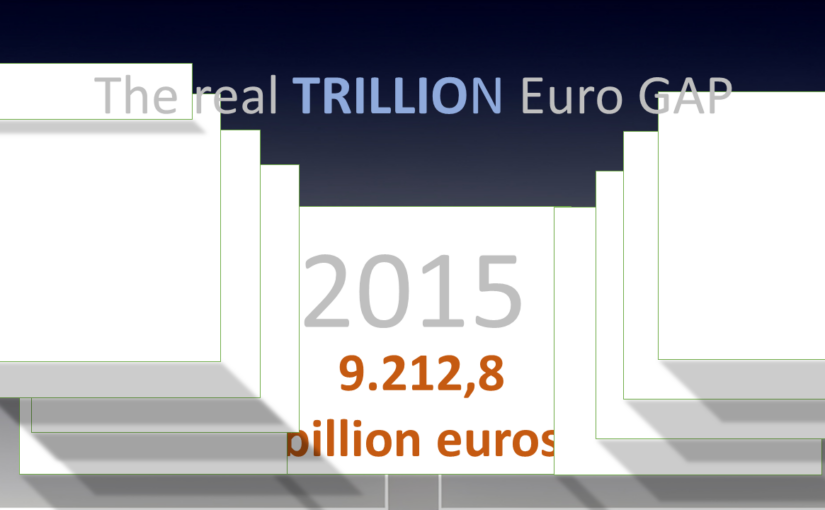
4. GAP 2015: Lack of Transparency Costs Trust and Productivity
Carryover from Previous Years:
- 2000: Mannesmann takeover – €133 billion (loss of European sovereignty)
- 2001–2007: Unemployment due to GraTeach blockade – €18 billion
- 2004–2006: Revenue losses due to US platforms – €54.3 billion
- 2003–2014: Loss of trust in economy & digitalization – €6,272 billion
- 2008: Financial crisis (10% of €5.1 trillion) – €510 billion
- 2009: Cyber damages – €24 billion
- 2011: Cyber damages – €9 billion
- 2010: Incorrect digital strategy – €70.5 billion
- 2010: GDP decline in the EU – €200 billion
- 2011: Cyber damages – €9 billion
- 2012: Cyberattacks – €24 billion
GAP 2015:
- Loss of trust (13% of 2015 GDP: €14.6 trillion) – €1,898 billion
Total GAP 2015: €9,212.8 billion
Summary:
- Lack of transparency in the judiciary and administration persisted.
- No implementation of the Finder system or EU-D-S, despite the technologies already being available.
- No investigation into the attacks on me—despite my applications to the Office for the Protection of the Constitution.
Revenue of Google and Amazon (2015):
- Google: ~$74.5 billion (approx. €67 billion)
- Amazon: ~$107 billion (approx. €96 billion)
These corporations benefited from the centralization of data—the exact opposite of what EU-D-S stands for.
Events in Europe in 2015 that would have changed with EU-D-S:
- Cyberattacks on the Bundestag: Could have been prevented through decentralized structures.
- GraTeach insolvency: Transparency through the Finder system would have exposed manipulations.
- Refugee crisis: A European WAN-anonymous identity (in the EU-D-S) would have facilitated coordination—instead of national solo efforts.
- TTIP negotiations: Data sovereignty would have remained with Europe, not with US corporations.
Possible Developments (1999–2007):
- 1999: Finder technology could have brought early transparency to administration and economy.
- 2002: getmysense could have given citizens control over digital data.
- 2003: GISAD could have combined data protection and location services.
- 2004: EU-D-S could have given Europe digital sovereignty.
- 2007: WAN anonymity could have made mass surveillance impossible.
Conclusion: While gatekeepers expanded their power, Europe remained trapped in dependence and opacity. Trusted WEB 4.0 would have been the way out—but it was obstructed and not implemented.
—