
1. Real Situation in 2016: Compatibility with Pre-Digital State Not Achievable
After presenting Trusted WEB 4.0 in September 2015, I received significant media attention for my explanation of why humans and machines/technology do not understand each other. Against this backdrop, I prepared the founding of GISAD in 2016. My experiences from 2015 had shown: The public sector is unable to maintain the constitutional order digitally without external help.
Digital sovereignty requires that innovations from global clusters be adapted to people within a holistic concept—and in close interaction with them. Every person has specific strengths. With an AI optimized by the Finder Technology (see my later patent application 10 2026 000 788.7), such a comprehensive concept could be implemented. Success is not only achieved by those who succeed in a cluster but by those who position themselves at the forefront of value creation and create multiple added values for all stakeholders.
Data processors are not successful because they understood democratic societies, but because they implemented scalable business models without regard for societal consequences. For founders, startups become a gamble. Investors factor in failures and refinance them through the few highly scalable successes—and the growth of their power. They can monitor, manipulate, and expand their power through division.
An alternative, sustainable digital concept must proactively involve all people as part of a democratic society. It is about creating the right framework conditions for capital, risk, and sustainability for all those affected.
Despite investments of €6.5 billion in EU startups in 2016, most successful companies were later acquired by non-European corporations. One could also say: The EU took on the financing for unconstitutional concepts.
2. Development Without Obstruction: From Democratic Guiding Principle to Self-Sustaining System
If the Finder Technology had been consistently implemented since 2000, its category structure would have automatically created a comprehensive system comparable to the EU-D-S. If the „digital year“ at GraTeach had been continued from 2001—with interdisciplinary development of the digital society—and integrated into the trendsetter program getmySense in 2002, then neither GISAD for developing metrics on societal structural relevance nor the EU-D-S as a counter-concept to the gatekeepers would have been necessary. The existing autocratic digital concepts would have had no chance.
Today’s democratic upheavals could have largely been avoided. Citizens would have been able to compare the concept of Trusted WEB 4.0 with gatekeeper concepts. They would have had to adapt much less to a disruptive new situation. Proven societal structures would have been preserved.
3. A Look from the Future (2026): Capital, Risk, and Sustainability for All Stakeholders
Even in 2026, GISAD is still in the process of being founded. The EU and Germany are increasingly providing funds to preserve democracy. But in a digital world, a concept of independent media and freedom of information falls short.
Often, politicians accused me, saying I should „just do it.“ But politics has no conscience—even if contracts were not honored in the past and the constitution was trampled on, they believe I would simply embark on the next adventure. I will not found GISAD alone. Only if as many founders as possible come together, as envisioned in the EU-D-S concept, will negotiations with the public sector be possible on equal terms.
The discussion about sustainability shows: A holistic consideration of all forms of capital (natural, social, human, financial, and physical capital) is necessary. Economic growth must not come at the expense of natural or social capital—this endangers long-term quality of life and societal stability. A strong focus on sustainability creates ecological, social, and economic stability.
Unlike politicians, medium-sized companies are long-term oriented—hence sustainable. They can be most successful in a comprehensive digital concept that aligns with the capital, risk, and sustainability interests of investors, the state, and citizens. This creates a European competitive advantage over the USA. The increasing societal upheavals caused by social media show: US concepts are socially harmful. The gatekeepers only stay afloat through the immense capitalization of their scalable business models—based on agitation. In a sustainability analysis for all stakeholders, they would have failed long ago.
Today’s democratic upheavals could have largely been avoided. Citizens would have been able to compare the concept of Trusted WEB 4.0 with gatekeeper concepts. They would have had to adapt much less to a disruptive new situation. Proven societal structures would have been preserved.
Given my 25 years of experience with digitalization as a driver of autocracy, it seems plausible that the blocking of Fable 5 and Mythos 5 reflects not only security concerns but also the strategic interests of the USA. The gatekeepers have shown over the past decades that they hinder democracy and diversity when these obstruct their scaling and power plans. Trusted WEB 4.0 concepts, which include decentralized data sovereignty, transparent algorithms, and a European infrastructure, can break these dependencies and strengthen digital sovereignty, regardless of the AI used.
Solution Approaches for the EU-D-S:
With GISAD and its metrics for societal structural relevance, I align projects with internationally recognized parameters:
- Health
- Material living conditions
- Productive or main activity
- Education
- Leisure and social interactions
- Economic and physical security
- Rule of law and fundamental rights
- Natural environment and living conditions
- General sense of well-being
Sustainability as Capital Providers:
Capital providers assume that most startups will fail. This only makes sense if individual founders are exponentially successful and offset the losses of others. But even with wealth, one prefers to live in a socially developed country rather than in chaos.
Trusted WEB 4.0 Solution: A fund or special fund for the EU-D-S finances startups in all 1,000 categories—ensuring that no societal aspect is overlooked.
Sustainability for Entrepreneurs:
Founders often burn through a lot of money without succeeding. Failure ruins them and harms their professional future. At the same time, they gather valuable know-how that could help other founders.
Trusted WEB 4.0 Solution: In the EU-D-S, a founder receives a dynamic monopoly in the category where they are the leader. This minimizes the risk of failure. If a startup is not successful, another founder can introduce their own idea and take over the startup. The failed founder is integrated through participation or employment—harsh failure is avoided. Democratic control is exercised through the Council of Disciplines (www.get-primus.com).
Sustainability for the State:
The state can focus on the pre-digital constitutional society. As early as 2016, it was foreseeable that European states would not find solutions for declining revenues with rising social costs and pensions in a digital society.
Trusted WEB 4.0 Solution: In the EU-D-S, entrepreneurs are promoted within the available budgets—e.g., by converting social costs into participation payments (as discussed in 2013).
Sustainability for Citizens:
Citizens receive a second pillar for their pension, e.g., through a generational fund.
States and Short-Term Solutions:
States do not think like entrepreneurs and cannot implement short-term solutions. In practice, gatekeepers in the USA already determine government actions.
Trusted WEB 4.0 Solution: After successful pilot projects, saved transfer payments can be paid out to EU-D-S companies.
4. GAP: No Growth Without Trust in Sustainability!
Carryover from Previous Years:
- 2000: Mannesmann takeover – €133 billion (loss of European sovereignty)
- 2001–2007: Unemployment due to GraTeach blockade – €18 billion
- 2004–2006: Revenue losses due to US platforms – €54.3 billion
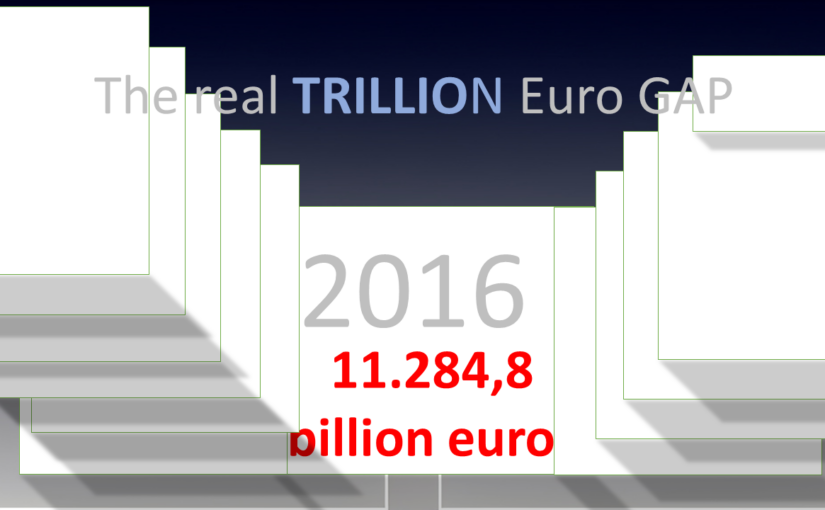
- 2003–2015: Loss of trust in economy & digitalization – €8,170 billion
- 2008: Financial crisis (10% of €5.1 trillion) – €510 billion
- 2009: Cyber damages – €24 billion
- 2010: Wrong digital strategy – €70.5 billion
- 2010: GDP decline in the EU – €200 billion
- 2011: Cyber damages – €9 billion
- 2012: Cyberattacks – €24 billion
GAP 2016:
- Loss of trust (14% of 2016 GDP: €14.8 trillion) – €2,072 billion
Total GAP 2016: €11,284.8 billion
Events in Europe in 2016 that would have changed with EU-D-S:
- „Investigatory Powers Act“ in the UK („Snoopers’ Charter“) – widespread surveillance would have been avoided by Trusted WEB 4.0 and WAN Anonymity (from 2007).
- EU-wide data retention for passenger name records (PNR) – EU-D-S would have provided a data-sovereign alternative.
- Coordination of intelligence services in the „Paris Group“ – with EU-D-S, a European Digital Union with transparent control would have been possible.
- BKA Act 2016 in Germany (electronic ankle monitors, expansion of the BKA as the main hub) – WAN Anonymity would have preserved civil rights and simultaneously secured more forensic evidence.
- Poland’s Anti-Terrorism Act (covert surveillance without judicial oversight) – Trusted WEB 4.0 would have upheld the rule of law.
Possible Developments (1999–2007):
- 1999: Finder technology could have brought early transparency to administration and economy.
- 2002: getmysense could have given citizens control over digital data.
- 2003: GISAD could have combined data protection and location services.
- 2004: EU-D-S could have given Europe digital sovereignty.
- 2007: WAN anonymity could have made mass surveillance impossible.
Conclusion: While gatekeepers expanded their power, Europe remained trapped in dependence and opacity. Trusted WEB 4.0 would have been the way out—but it was obstructed and not implemented.
Sources
-
Netzpolitik.org: Year in Review – The Expansion of the Surveillance State in 2016
Describes, among other things, the „Investigatory Powers Act“ in the UK, EU-wide data retention for passenger name records (PNR), and the coordination of intelligence services in the „Paris Group“.
-
Netzpolitik.org: Chronicle of the Surveillance State
Documentation of the „Directive (EU) 2016/681“ on the storage of passenger name records (PNR).
-
World Socialist Web Site: More Surveillance Laws Eliminate Democratic Basic Rights
Analysis of the BKA Act 2016 in Germany.
-
Amnesty International: Anti-Terror Laws Undermine Fundamental Rights in Europe
Report on surveillance laws in Europe in 2016, including Poland’s Anti-Terrorism Act.
-
Statista: Google Revenue 2016
-
Statista: Amazon Revenue 2016
- heise online: US Government Forces Shutdown of Anthropic’s AI Fable 5 and Mythos 5
- ADVISORI: Fable 5 Ban – Why the USA Blocked Claude
- Techboys: Claude Fable 5 Blocked
- finanzen.net: US Order Slows Down AI – Anthropic Stops Fable 5 and Mythos 5
- tagesschau: Security Concerns – Anthropic Must Block Latest AI Versions
- Global Surveillance and Espionage Affair – Wikipedia
- Süddeutsche Zeitung: Geopolitical Consequences of the Snowden Revelations
- Tagesspiegel: Cybercrime in Germany 2013
- Statista: Gross Domestic Product (GDP) in the European Union (EU)
- Handelsblatt: Warning of Blackout Risks Due to Manipulable IoT Updates (2019)
- datensicherheit.de: 90% of IoT Firmware with Critical Security Vulnerabilities (2019)
- DW: €100 Billion in Damages from Cyberattacks in Germany (2019)
- datensicherheit.de: €43 Billion in Damages in German Industry (2018–2019)
- Digital Engineering Magazin: €9.6 Billion Wasted on Unused Software in Europe (2019)
Shutdown of Anthropic’s AI Fable 5 and Mythos 5: