
1. Real Situation in 2017: De Facto Censorship Prevents Discussion on Preserving Democracy
My professional books published by Springer on the blueprint for a digital society and the infrastructure for a digital constitution were added to the library of the German Bundestag but systematically ignored by the press. Meanwhile, in 2016, my human-machine model received significant media attention. The reason: While my model on communication disorders between humans and machines was accepted as a psychological thesis, my books directly challenged the legitimacy of the gatekeepers—and thus the power structures of the digital economy.
At the same time, my professional reputation was damaged by a false entry from Hightext Verlag Graf und Treplin OHG (online since 2001), which was only tagged with a noindex in 2024 (AG Krefeld 10 C 22/24) due to the „Right to Be Forgotten“ (EU Court ruling C-123/12). Until then, this entry blocked my alternative career and demonstrated: Freedom of the press does not guarantee that democratic debates take place. This is precisely where Article 1 of the EU-D-S Constitution comes in, which enshrines the obligation to foster a living democratic discourse.
2. Development Without Obstruction: Active Societal Discussion for Digital Inclusion
Without the de facto censorship of my work, Finder Technology (since 2000) and getMySense since 2002 – could have enabled a new culture of discussion. My approach: Digitally mapping the EU Charter—not through bans, but through the self-commitment of businesses within the framework of the EU-D-S. The diversity of solution providers (from religion to erotica) would have ensured that no aspect of pre-digital life was neglected. Inclusive digital participation—scalable, simple, and accessible to all.
3. A Look from the Future (2026): Capital, Risk, and Sustainability for All Stakeholders
Today, I see how the petition for a Right to an Analog Life points to the exclusion of around one million citizens in Germany alone from the digital society but offers no solution. Such a right would further weaken the economy and create new bureaucracy—instead of reducing it. It would result in a two-class society with additional red tape. The real solution lies in the 1985 breakthrough, when adult illiterates learned to read and write using an individualized method: Digital participation must be as simple as this method—not as complex as the current interaction between humans and AI, and the resulting complicated regulation of gatekeepers without effective impact.
The debate about Anthropic’s myth and AI control shows: We are losing control over AI systems because speed, data volume, and impacts are no longer manageable. The USA dominates AI development through massive capital—and thus creates a „killswitch scenario„: Either you submit to our protection, or we switch you off. Here, retroactive digital laws or funding are of no use. Only a holistic European digital concept—like Trusted WEB 4.0—can secure digital sovereignty.
Pope Leo XIV emphasizes this in his encyclical „Magnifica Humanitas“ (2026): „Disarmament means breaking the equation between technical power and the right to rule.“
This is exactly what the EU-D-S achieves: Diversity through citizens behind the smallest meaningful units and businesses behind defined categories. No area of life is excluded—and thus all people are included.
—
4. GAP 2017: Digital Uncertainty Without an Adapted Societal Concept
Carryover from Previous Years:
- 2000: Mannesmann Takeover – €133 billion (Loss of European Sovereignty)
- 2001–2007: Unemployment due to GraTeach Blockade– €18 billion
- 2004–2006: Revenue Losses due to US Platforms – €54.3 billion
- 2003–2016: Loss of Trust in Economy & Digitalization – €10,242 billion
- 2008: Financial Crisis (10% of €5.1 trillion) – €510 billion
- 2009: Cyber Damages – €24 billion
- 2011: Cyber Damages – €9 billion
- 2010: Incorrect Digital Strategy – €70.5 billion
- 2010: GDP Decline in the EU – €200 billion
- 2011: Cyber Damages – €9 billion
- 2012: Cyberattacks – €24 billion
GAP 2017:
- Loss of Trust (14% of 2017 GDP: €15.1 trillion) – €2,114 billion
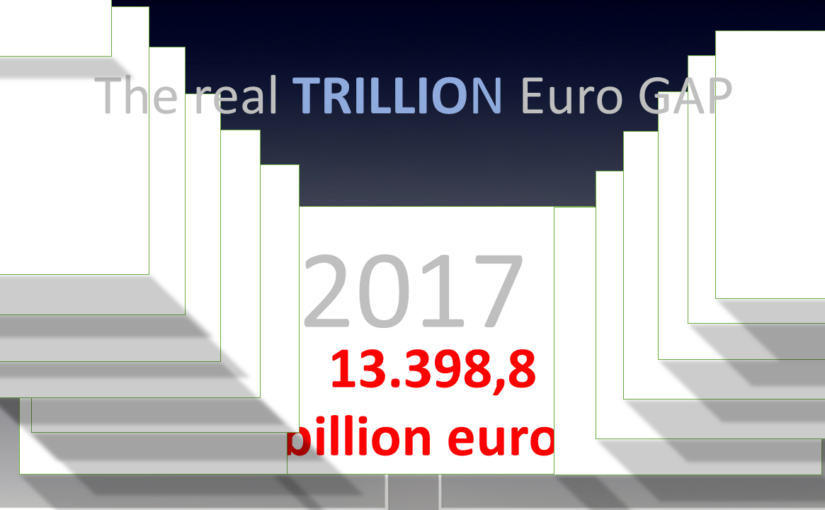
Total GAP 2017: €13,398.8 Billion
If the EU had avoided the GAP, it would not have had any debt in 2026 and could still have invested significantly in digital infrastructure:
The total debt of the EU (EU-27) for 2026 is not directly stated as an absolute figure in current sources. However, the EU’s debt-to-GDP ratio is 82.1% (as of Q3 2025, published January 2026). With an estimated EU-27 GDP of around €16.4 trillion (2022) and a slight increase in subsequent years, this would imply a debt level of approximately €13.5 trillion for the EU-27 in 2026.
In 2017, the gatekeepers (Google, Amazon) dominated with revenues of €97.55 billion (Google) and €156.55 billion (Amazon)—sums that could have flowed into European alternatives but instead cemented Europe’s dependence. While the European Commission imposed a record fine of €2.4 billion on Google for abuse of market dominance, this did not solve the structural problem: Europe reacts instead of shaping.
Possible Developments (1999–2007):
- 1999: Finder technology could have brought early transparency to administration and economy.
- 2002: getmysense could have given citizens control over digital data.
- 2003: GISAD could have combined data protection and location services.
- 2004: EU-D-S could have given Europe digital sovereignty.
- 2007: WAN anonymity could have made mass surveillance impossible.
—
Sources
1. Arguments and Links by Olaf Berberich
- Professional Books by Olaf Berberich (Springer, 2016)
- Article: „Know-it-all – Even at Year’s End: I Told You So, When Will You Finally Listen?“
- 1985 Breakthrough: Individualized Method for Adult Illiterates
- EU-D-S Constitution (Article 1: Obligation to Foster Living Democratic Discourse)
- Digital Compass Policy (Solution Proposals for EU-D-S)
- Petition: Right to an Analog Life in the Basic Law (2026)
- Article: „Myth vs. GPT-5.5 Cyber: Why the EU Parliament Is Now Sounding the Alarm on Security AI“
2. Papal Encyclicals (2017 and Later)
- Laudato Si’ (2015, but still central in 2017): Encyclical by Pope Francis on Integral Ecology and Social Justice
- Official List of Encyclicals by Pope Francis (Vatican)
- Scientists Respond to the Encyclical „Laudato Si’“ (2017, Psychosozial-Verlag)
- Book: „Laudato Si’: Scientists Respond to Pope Francis’ Encyclical“ (2017)
- Pope Leo XIV: First Encyclical „Magnifica Humanitas“ (2026) – Call for the Disarmament of AI
3. Revenues of Google and Amazon (2017)
- Alphabet (Google) Q4 2017: $32.32 billion revenue (≈ €28.64 billion)
- Alphabet (Google) Q3 2017: $27.72 billion revenue (≈ €24.49 billion)
- Alphabet (Google) Q2 2017: $26.01 billion revenue (≈ €22.97 billion)
- Statista: Google’s Global Revenue (2017: ≈ €97.55 billion)
- Amazon’s Revenue in Germany 2017: ≈ €15 billion
- Amazon Germany Revenue 2017: €13.7 billion (20% growth)
- Amazon & Google Quarterly Figures 2017: Revenue Development and Profits
- Amazon’s Revenue in Germany 2017: $16.95 billion (≈ €15 billion)
- Trade Data: Amazon’s Revenue in Germany (Time Series)
4. EU Law and Regulation (2017)
- European Commission: Record Fine Against Google (€2.4 billion, 2017) for Abuse of Market Dominance
- CJEU Ruling C-131/12 (Google Spain): Right to Be Forgotten
5. The EU Would Be Debt-Free!
„`