
1. Real Situation in 2023: Hindered by a „Organized Gang-Like Pattern of Appearance“
After I filed my application against the Ukraine war in 2022, I once again had to bear the consequences, see Organized Gang-Like Pattern of Appearance.
Mythos was banned by the US government, allegedly due to structural vulnerabilities. From my own perspective, facing 11 years of criminal prosecution without a hearing or legal basis, I ask myself: Is this really about technical security flaws—or rather about structural weaknesses of states that the US government has exploited or even supported since 9/11?
For example, I simply do not understand why there is no upper limit to the number of lawyers that can be reasonably imposed, and why, in this case, there is no option for self-representation (2BvR 1668/25). This forces me to achieve a result in the first instance. This blog is my only protection, as I now have to conduct every legal process publicly to secure my rights. Since 2022, I have been financially damaged by alleged moisture in a rental property—my main source of income—where I had to relocate a bathroom and kitchen to avoid suspected moisture entering through a co-owner’s balcony.
Mythos might also provide evidence of unfair US methods to exploit the corona situation for anti-democratic digitization through US products. Undeniably, Corona led to significant growth for gatekeepers and simultaneously to an economic downturn in Europe.
There is also provable evidence of a missed opportunity for digital migration integration through Trusted WEB 4.0:
The corona pandemic led to isolation among EU states, costing economic growth and jobs. Instead of using this crisis as a catalyst to establish digital work models and inclusive value creation, the opportunity to linguistically and digitally integrate migration applicants into the EU-D-S Digital Union was missed. A functional Trusted WEB 4.0 would have allowed qualified workers worldwide—regardless of their location—to be integrated in their native language, their performance evaluated digitally, and only the best selected for later immigration. This would have prevented deportation centers, skilled labor shortages, and social tensions.
2. Development Without Obstruction: Europe as a Digital Role Model
What could Trusted WEB 4.0 have prevented?
• Digital Integration of Migration Applicants:
Trusted WEB 4.0 could have provided a language-independent, decentralized platform, as described in 2018, where migration applicants could receive and process digital work assignments in their native language. Through AI-supported performance evaluation and blockchain-based certification, skills and reliability would have been objectively measurable—without physical presence.
→ Result: Only proven workers would have immigrated, improving migration quality and making deportation centers obsolete.
• Economic Resilience Through Digital Work Models:
The pandemic-driven shift to remote work could have been made a permanent solution for global talent. Trusted WEB 4.0 would have enabled companies to collaborate with migration applicants regardless of location before their physical arrival.
→ Result: Economic growth and jobs would not have been lost but strengthened through digital value creation.
• Social and Political Stability:
Transparent, fair digital evaluation processes would have avoided accusations of arbitrariness in migration. Decentralized data sovereignty would have ensured that applicants‘ personal data remained protected and only released upon successful validation for immigration.
→ Result: Social tensions from uncontrolled migration or deportations would have been reduced.
• Prevention of Deportation Centers:
Preventive digital integration would have ensured that only individuals who had already demonstrably contributed to European value creation would enter.
→ Result: This would have significantly reduced the need for deportation centers and complex asylum procedures.
3. A Look from the Future (2026): The Opportunity of Corona for Digital Democratic Renewal Was Squandered
There are two false assumptions:
The first assumption is that AI takes away our jobs, the second is that current systems improve the world. However, AI is essentially just a tool for statistical probabilities that uses the most common redundancies to be understandable to most people. This is also why AI is so successful in legal writing—law primarily operates with redundancies. Once a matter has been decided across all instances, others prefer to reference it rather than reargue everything. In other words: AI consolidates societal structures.
Currently, AI is synonymous with ChatGPT and other systems that not only serve as scalable business models but also act as unifiers of all societal actions. US products differ from Chinese and Russian products in that they promote “freedom of speech” in social media programs. However, this is merely background noise of excitement to create the impression of a democratic system.
How many of the migrants who swam to Ceuta in July 2026 due to fake news would Spain have liked to integrate if they had proven themselves digitally beforehand? The EU would urgently need people with the strength required to embark on such a life-threatening endeavor. But not all of them.
First and foremost, AI is nothing more than an advanced calculator. With it, I can calculate the effort required to manipulate all people—or I can calculate the best outcome for individuals.
The input is decisive.
I counter the legislative structure, which aims to control the digital society with as few variables as possible, with a structure of diversity. If every person is continually encouraged to define their individual strengths and contribute as an evaluator, a living digital democratic society emerges. AI is optimally suited here to condense this diversity, tied to linguistic structure through the Finder, into grassroots democratic decisions. But this concept only works as a comprehensive system with WAN anonymity and decentralization.
Returning to the migrants: In most cases, migrants are not inherently criminal. Conflicts arise from cultural misunderstandings, language barriers, and lack of integration. All of this could have been addressed by Trusted WEB 4.0 within a Digital Union in advance. Physical immigration does not even have to be the goal. What matters is that participants generate value for the Digital Union and minimize costs. Even if wars do not need to be fought, high societal costs can be saved. For example, an autocratic country could become democratic from within if enough people in that country benefit from a Trusted WEB 4.0.
4. GAP 2023: Missing Economic Growth Due to Corona
Carryover from Previous Years:
- 2000: Mannesmann takeover – €133 billion (loss of European sovereignty)
- 2001–2007: Unemployment due to GraTeach blockade – €18 billion
- 2004–2006: Revenue losses due to US platforms – €54.3 billion
- 2003–2022: Loss of trust in economy & digitization – €27.7 trillion
- 2008: Financial crisis (10% of €5.1 trillion) – €510 billion
- 2009: Cyber damages – €24 billion
- 2011: Cyber damages – €9 billion
- 2010: Wrong digital strategy – €70.5 billion
- 2010: GDP decline in the EU – €200 billion
- 2011: Cyber damages – €9 billion
- 2012: Cyberattacks – €24 billion
GAP 2023:
- Loss of trust (23% of 2023 GDP: €16.7 trillion) – €3.841 trillion
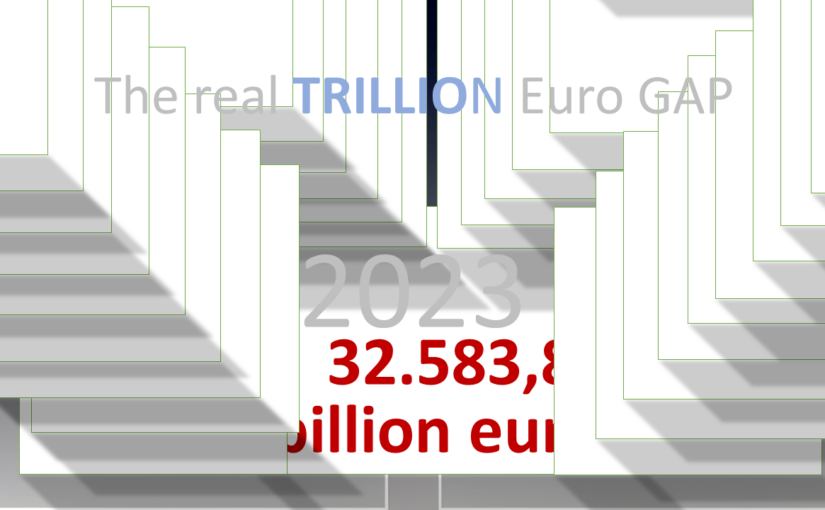
Total GAP 2023: €32.5838 trillion
Individual Damages in Europe in 2023 (in billions of euros, rounded)
| Area | Damage (2023) |
|---|---|
| Economic losses due to isolation and skilled labor shortage | €250 billion |
| Costs for deportation centers and asylum procedures | €15 billion |
| Social follow-up costs (integration, conflicts) | €30 billion |
| Total | €295 billion |
Trusted WEB 4.0 technologies such as
Finder (1999),
getmysense (2002),
GISAD (2003),
EU-D-S (2004),
and WAN anonymity (2007)
could have served as the foundation for a European digital alternative.
Sources from Trusted Web 4.0 Analysis:
- Closing the Trillion-Dollar Gap in Public Payments | BCG
- Bridging the Trillion-Dollar Gap: How Indonesia is Rethinking Development Finance | Joint SDG Fund
- Digital transformation and financial performance: an empirical analysis of strategic alignment in the digital age | Journal of Enterprising Communities: People and Places in the Global Economy | Emerald Publishing
- List of Data Breaches and Cyber Attacks in 2023 – 8,214,886,660 records breached | GRC Solutions
- ISACA Now Blog 2024: Unlocking the Power of Digital Trust Exploring ISACA’s Digital Trust Ecosystem Framework | ISACA
- 4 security threats for 2023 | Security Magazine
- Global Risks Report 2023: We know what the risks are – here’s what experts say we can do about it | World Economic Forum
- The 2024 Events That Could Change the World | Newsweek
- Ten Most Significant World Events in 2023 | Council on Foreign Relations
- Ten Most Significant World Events in 2024 | Council on Foreign Relations
- How Japan’s ‚trusted web‘ could improve digital governance | World Economic Forum
- 10 Major Cyberattacks And Data Breaches In 2023 | CRN
- 12 most significant 2023 data breaches | NordLayer Blog
- 2023 Will Go Down for Record-Setting Number of Data Breaches | Security Magazine
- Top 10 Corporate Cybersecurity Breaches of 2023 | Aeris
- A year in review: 10 of the biggest security incidents of 2023 | Security Magazine
- Data breaches increased in 2023 and with them, internet security concerns | The Week
- Data breaches increased throughout 2023 | Security Magazine
- Why Data Breaches Spiked in 2023 | Cybersecurity Magazine
- 41.9m records compromised by cyber breaches in March 2023 | Cybersecurity Magazine
- Disinformation is a threat to our trust ecosystem. Experts explain how to curb it | World Economic Forum
- Trust, Media Credibility, Social Ties, and the Intention to Share towards Information Verification in an Age of Fake News | PMC
- The 2017 Survey: The Future of Truth and Misinformation Online, Part 1 of 6 | Imagining the Internet, Elon University
- Countering Disinformation Effectively: An Evidence-Based Policy Guide | Carnegie Endowment for International Peace
- The Future of Truth and Misinformation Online | Pew Research Center
- Here are UNESCO’s 5 principles to govern digital platforms | World Economic Forum
- Internet for Trust | UNESCO
- Towards the next technological transition: Commission presents EU strategy to lead on Web 4.0 and virtual worlds | Shaping Europe’s digital future
- Trust and technology: how digital confidence shapes global economic performance and sustainable development | Humanities and Social Sciences Communications
- Transforming Global Trade and Development With Digital Technologies | ITIF