
1. Actual Situation in 2024: NRW Has Not Learned from the Past!
As a plaintiff, I must note after my political application against the Ukraine war and without the possibility of legal representation that remote control by the state of NRW and the failure to provide assistance to me as an entrepreneur create unbearable risks if I continue to offer alternatives to gatekeeper concepts. A past that has not been addressed remains unresolved, as seen in the lawsuit 10 C 367/23 (Amtsgericht Krefeld). The resulting complaint to the ECtHR was not accepted for decision.
The state of NRW sees no way to act against:
- Digital dependency (on US platforms) undermining democratic processes (e.g., disinformation, polarization).
- Lack of digital participation (e.g., due to monopolies like Google) exacerbating social division and economic damage.
- Loss of pre-digital achievements (e.g., anonymity, data protection, equality) that must be preserved in digitization.
2. Development Without Obstruction: Focus on Pre-Digital Achievements
I proved to the Ministry of Justice, Dr. Buschmann (who provided positive feedback), that special digital legislation is not necessary (e.g., for age restrictions in social media), if instead a framework is created for the economy that protects the pre-digital democratic systems successfully developed over decades. Replicating this concept in the digital space leads to sustainable value creation.
At this point, GISAD should function as a clearing house for the economy, ensuring compliance with pre-digital legislation within the Trusted WEB 4.0. An additional grassroots democratic component would emerge through the evaluators in getmysense.
3. A Look from the Future (2026): Limited Digital Government Competence!
After World War II, democracies made significant progress. The fact that 27 states within the EU engage in democratic discourse with one another is a unique process worldwide. This system should therefore continue to exist in the future.
On the other hand, disruptive digitization has increasingly moved away from democratic principles in the interests of a very small group of people. Individuals are exhausting. For many years, there have been economic arguments for standardizing people.
It began with cheap mass production, which suddenly allowed many more people to afford things at low prices. In return, they willingly gave up a bit of individualism. Further standardization occurred through advertising. When people were repeatedly exposed to the same advertisements, needs were created that would not have existed without advertising.
The next step was social media, where traffic was generated through artificial excitement, creating an artificial market where advertisers had to pay even more to reach their target audience. With the FINDER technology, consumers and providers find each other in the fastest way, while individuality is preserved and even promoted.
Politics in Europe is clearly unable to proactively maintain a livable democratic society. Its legislation always tries to prevent the worst in hindsight. Because it does not understand the consequences of new technologies, most democracies are now in decline.
If politics cannot act proactively, it must not claim responsibility to the citizens for doing so. This is precisely why we have political disillusionment.
4. GAP 2024: Lack of Digital Democracy Understanding!
Carryover from Previous Years:
- 2000: Mannesmann takeover – €133 billion (loss of European sovereignty)
- 2001–2007: Unemployment due to GraTeach blockade – €18 billion
- 2004–2006: Revenue losses due to US platforms – €54.3 billion
- 2003–2023: Loss of trust in economy & digitization – €31.541 trillion
- 2008: Financial crisis (10% of €5.1 trillion) – €510 billion
- 2009: Cyber damages – €24 billion
- 2011: Cyber damages – €9 billion
- 2010: Wrong digital strategy – €70.5 billion
- 2010: GDP decline in the EU – €200 billion
- 2011: Cyber damages – €9 billion
- 2012: Cyberattacks – €24 billion
GAP 2024:
- Loss of trust (24% of 2024 GDP: €17.1 trillion) – €4.104 trillion
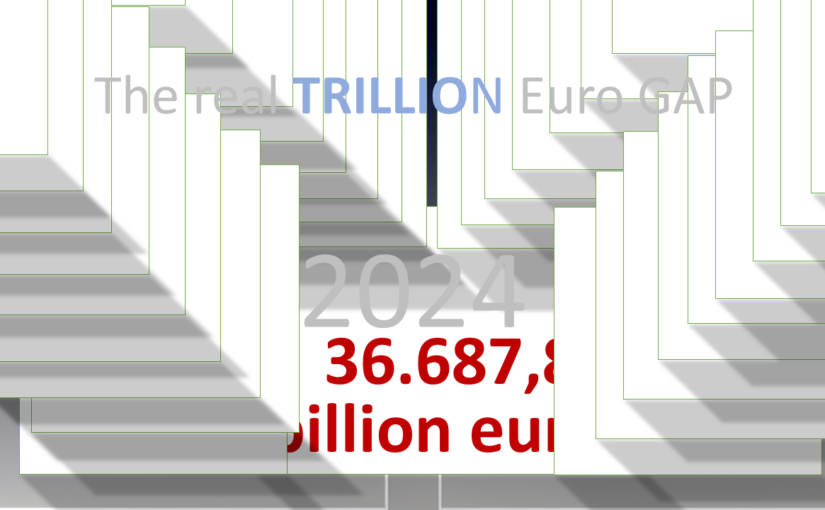
Total GAP 2024: €36,69 trillion
Trusted WEB 4.0 technologies such as
Finder (1999),
getmysense (2002),
GISAD (2003),
EU-D-S (2004),
and WAN anonymity (2007)
could have served as the foundation for a European digital alternative.
Sources
- Why digital trust is key to building thriving economies | World Economic Forum
- Industry News 2023: The Role of Transparency and Accountability in Digital Transformation
- Web 4.0 Explained: Definition, Technologies, and What It Means for the Future of the Internet
- Closing the Trillion-Dollar Gap in Public Payments | BCG
- Bridging the Trillion-Dollar Gap: How Indonesia is Rethinking Development Finance | Joint SDG Fund
- Digital transformation and financial performance: an empirical analysis of strategic alignment in the digital age | Journal of Enterprising Communities: People and Places in the Global Economy | Emerald Publishing
- List of Data Breaches and Cyber Attacks in 2023 – 8,214,886,660 records breached | GRC Solutions
- ISACA Now Blog 2024: Unlocking the Power of Digital Trust Exploring ISACA’s Digital Trust Ecosystem Framework | ISACA
- 4 security threats for 2023 | Security Magazine
- Global Risks Report 2023: We know what the risks are – here’s what experts say we can do about it | World Economic Forum
- The 2024 Events That Could Change the World | Newsweek
- Ten Most Significant World Events in 2023 | Council on Foreign Relations
- Ten Most Significant World Events in 2024 | Council on Foreign Relations
- How Japan’s ‚trusted web‘ could improve digital governance | World Economic Forum
- 10 Major Cyberattacks And Data Breaches In 2023 | CRN
- 12 most significant 2023 data breaches | NordLayer Blog
- 2023 Will Go Down for Record-Setting Number of Data Breaches | Security Magazine
- Top 10 Corporate Cybersecurity Breaches of 2023 | Aeris
- A year in review: 10 of the biggest security incidents of 2023 | Security Magazine
- Data breaches increased in 2023 and with them, internet security concerns | The Week
- Data breaches increased throughout 2023 | Security Magazine
- Why Data Breaches Spiked in 2023 | Cybersecurity Magazine
- 41.9m records compromised by cyber breaches in March 2023 | Cybersecurity Magazine
- Disinformation is a threat to our trust ecosystem. Experts explain how to curb it | World Economic Forum
- Trust, Media Credibility, Social Ties, and the Intention to Share towards Information Verification in an Age of Fake News | PMC
- The 2017 Survey: The Future of Truth and Misinformation Online, Part 1 of 6 | Imagining the Internet, Elon University
- Countering Disinformation Effectively: An Evidence-Based Policy Guide | Carnegie Endowment for International Peace
- Online misinformation and disinformation reform Impact Analysis September 2024
- National Priorities to Combat Misinformation
- The Future of Truth and Misinformation Online | Pew Research Center
- Here are UNESCO’s 5 principles to govern digital platforms | World Economic Forum
- Internet for Trust | UNESCO
- Towards the next technological transition: Commission presents EU strategy to lead on Web 4.0 and virtual worlds | Shaping Europe’s digital future
- Trust and technology: how digital confidence shapes global economic performance and sustainable development | Humanities and Social Sciences Communications
- Transforming Global Trade and Development With Digital Technologies | ITIF