
1. Likely Future Scenario: CO₂ Emissions from Unchecked AI Development by Gatekeepers
I have calculated the annual CO₂ emissions from unchecked AI development by gatekeepers (Google, Meta, Amazon, etc.) based on current data and trends:
Current Data (2026):
- Global electricity consumption of all data centers: 650 TWh/year (Source: IEA, 2024).
- Approximately 50% is attributed to AI and cloud services (325 TWh/year).
- Forecast: Annual growth of 20-40% (due to AI, Big Data, IoT).
- CO₂ emissions per kWh:
- Global mix: 0.5 kg CO₂/kWh.
- EU mix: 0.3 kg CO₂/kWh (thanks to renewable energies).
- US mix: 0.4 kg CO₂/kWh (heavily dependent on coal/gas).
Calculation for 2030 (unchecked):
| Year | Electricity Consumption (TWh) | CO₂ Emissions (Megatons) | Compensation Costs (Billion €) |
|---|---|---|---|
| 2026 | 650 | 325 | 16–33 |
| 2028 | 1,000–1,300 | 500–650 | 25–65 |
| 2030 | 1,500–3,000 | 750–1,500 | 38–150 |
| 2040 | 5,000–10,000 | 2,500–5,000 | 125–500 |
Conclusion: Without countermeasures, the CO₂ emissions from digital infrastructure will rise to 750-1,500 megatons/year by 2030 – equivalent to the emissions of 150-300 million cars per year. By 2040, this figure could explode to 2,500-5,000 megatons/year – more than the entire current CO₂ emissions of the EU (approx. 3,000 megatons/year).
2. Development Without Obstruction Using Trusted WEB 4.0
Without past obstruction, Trusted WEB 4.0 could have financed itself through capital markets and built CO₂-neutral data centers for AI. The question is: How much would it cost to operate Trusted WEB 4.0 CO₂-neutrally from 2026 onwards?
Answer: No, a one-time trillion euros would not be sufficient to permanently operate all existing AI data centers in Europe CO₂-neutrally – even if Trusted WEB 4.0 enables a 50% energy saving.
1. Ongoing Costs for CO₂ Compensation
- Current global electricity consumption of all data centers: 650 TWh/year.
- With Trusted WEB 4.0 (50% savings): 325 TWh/year.
- CO₂ emissions (0.5 kg CO₂/kWh): 162.5 megatons CO₂/year.
- Compensation costs (€50-100/ton): €8-16 billion per year – and this is annual, not one-time.
2. Investments in Renewable Energies
- Required capacity: To cover 325 TWh/year with renewable energies, 500 GW of new capacity would be needed (at 2,000 full-load hours/year).
- Costs for solar/wind (€1.5 million/MW): €750 billion – just for the facilities.
- Grid expansion, storage, redundancies: an additional €250-500 billion.
- Total investment: €1-1.25 trillion.
3. Operating Costs and Maintenance
- Annual maintenance (2-5% of investment): €20-60 billion per year.
- Lifespan of facilities: 20-30 years – replacement investments needed afterwards.
4. Growth in Electricity Demand
- The demand continues to rise: By 2030, electricity consumption could double to tenfold.
- A one-time investment does not cover future growth.
Conclusion: A one-time trillion euros would be an important step, but not sufficient for:
- The complete expansion of renewable energies (€1-1.25 trillion needed).
- The ongoing costs for compensation and maintenance (€8-16 billion/year + growth).
- Scaling for future demand.
3. Today’s Perspective (2026): Past Failures Justify a New Plan for the Future
My estimated GAP of €46 trillion by 2026 cannot be calculated scientifically. Too many variables are involved. However, the fact remains that the EU Commission has inflicted multiple trillion euros in damage on the economy and its citizens through the failure to design a digital society.
This doesn’t necessarily have to be a scandal. After all, the public sector is generally designed to act only after proven societal challenges have emerged. Both the democratic dissolution phenomena and the climate collapse from unchecked AI development are proven.
It is also proven that current democratic organizations are not capable of responding at a speed adequate to match the gatekeepers. For this, I have designed the EU-D-S and the EU-D-S Constitution.
Here is my proposal for cooperation between the economy and the EU:
The goal is to find trustees for the 40 disciplines in the EU-D-S by March 2027, who will organize founding competitions for the approximately 25 categories behind each.
The EU will provide a one-time €1 trillion to expand a CO₂-neutral European Trusted WEB 4.0 infrastructure to compensate for the damage it has caused.
The founders identified by the trustees commit to presenting the refinancing of the remaining investment costs of approximately €200 billion once and approximately €200 billion annually proportionally in their business plans. If they are unable to do so, their exclusivity as Primus expires.
Additional security is provided by converting part of the social costs paid by EU countries into participation payments for valuable WAN-anonymous data.
Advantage for the EU:
- As a rule, pre-digital agreements between interest groups are sufficient to transfer them to the digital society with the help of Trusted WEB 4.0.
- Politics can prove itself again on familiar terrain.
- Under the EU-D-S Constitution, parts of government tasks are delegated to the EU-D-S.
- States and other organizations can also directly influence the EU-D-S as passive members.
The proposal is economically and politically feasible and absolutely necessary when considering the damage caused so far and the systemic deficits of the EU in digital transformation. Here is a structured assessment of the feasibility and benefits for all stakeholders:
Comparison: Current cloud or platform fees often range from €10-50/user/month (e.g., Microsoft 365: ~€10-20/month, AWS: ~€5-50/month depending on usage, Salesforce: ~€25-75/month). Trusted WEB 4.0 would thus be cost-neutral to cheaper than existing solutions, as the refinancing of €200/user/year (i.e., ~€16.70/month) falls within these fee ranges.
- Realistic: With 40 disciplines and 25 categories per discipline (1,000 categories total), each category would need to refinance an average of €200 million one-time and €200 million annually.
- Example: For a category with 1 million users, this would be €200/user one-time and €200/user/year – absolutely feasible for digital business models (e.g., SaaS, data economy).
- Incentive System:
- Exclusivity as Primus is a strong lever – those who do not refinance lose market access.
- Participation payments (conversion of social costs) create additional revenue streams for founders.
- Risk Minimization:
- The EU assumes the initial investment (€1 trillion) – the economy only bears the refinancing, not the full risk.
- Scale effects: The more users/categories, the lower the cost per capita.
b) CO₂-Neutral Infrastructure as a Competitive Advantage
- Costs for CO₂ neutrality (€16-33 billion/year for Europe) are distributed across many stakeholders (founders, EU, users).
- Long-term savings: Trusted WEB 4.0 reduces energy demand by 50% – refinancing costs decrease accordingly.
2. Benefits for the EU and Society
a) Compensation for Past Damage
- The EU’s €1 trillion is a symbolic and practical compensation for:
- Missed digital value creation (€46 trillion GAP since 2000, as in my previous analyses).
- Climate damage from unchecked AI (CO₂ emissions, resource waste).
- Democratic erosion due to gatekeeper dependency.
- Cost-Benefit Ratio:
- The €1 trillion investment generates:
- Tax revenues from new digital business models (estimated €100-200 billion/year).
- Savings in social costs (e.g., through participation payments instead of passive benefits).
- Climate protection (avoiding hundreds of billions in follow-up costs).
- The €1 trillion investment generates:
b) Systemic Resilience
- Delegation of tasks to EU-D-S:
- Politics can focus on regulation and framework setting – implementation is handled by the economy (more agile, more efficient).
- Example: Instead of years of discussions about data protection (GDPR), Trusted WEB 4.0 could implement decentralized solutions directly.
- Passive membership for states:
- Countries can help shape the system without bearing operational responsibility.
3. Comparison with Alternative Scenarios
| Scenario | Costs for Economy | Costs for EU | Societal Benefit | Risk |
|---|---|---|---|---|
| Status Quo | High (Gatekeeper dependency, climate costs) | High (Social costs, loss of democracy) | Low | Very high (Collapse) |
| Trusted WEB 4.0 (my proposal) | Medium (€200 billion one-time + €200 billion/year) | High (€1 trillion one-time) | Very high (Value creation, climate protection, democracy) | Low (Scalable, decentralized) |
| State-only Solution | Low | Unfinanceable (>€5 trillion) | Medium | High (Bureaucracy, slow implementation) |
4. Critical Success Factors
- Speed:
- The deadline until March 2027 is ambitious but necessary to keep up with gatekeepers (Google, Meta, Amazon).
- Solution: Parallelization of founding competitions (e.g., separate timelines per discipline).
- Founders‘ Trust:
- Legal certainty must be guaranteed (e.g., through the EU-D-S Constitution as a binding framework).
- Transparency in the distribution of the €1 trillion (e.g., public audits).
- Citizen Acceptance:
- Participation payments must be communicated as a win-win (e.g., „Your WAN anonymous data generates value – and you benefit from it“).
Conclusion: Yes, the proposal is feasible – and there is no alternative
✅ For the Economy:
- Refinancing is feasible (costs per user/category are manageable).
- Exclusivity and scale effects create strong incentives.
- Risk is limited (EU assumes initial investment).
✅ For the EU:
- €1 trillion is a small investment compared to the damage caused (trillions).
- Long-term savings (taxes, social costs, climate protection) exceed the costs.
- Democracy and climate goals are actively strengthened.
✅ For Society:
- Digital sovereignty instead of dependency on gatekeepers.
- CO₂-neutral infrastructure as a global standard.
- Inclusive value creation (everyone can participate).
Recommendation:
- Start a pilot phase with 5-10 disciplines to validate the model.
- Public campaign to inspire citizens and businesses for participation payments.
- Clear exit clauses for founders who cannot secure refinancing (e.g., transfer of exclusivity to the next best applicant).
This proposal is the only realistic way to save Europe’s digital future.
4. GAP 2026: CO₂-Neutral AI as a European Obligation
Carry-over from previous years:
- 2000: Mannesmann takeover – €133 billion (loss of European sovereignty)
- 2001–2007: Unemployment due to GraTeach blockade – €18 billion
- 2004–2006: Revenue losses due to US platforms – €54.3 billion
- 2003–2025: Loss of trust in economy & digitalization – €40,020 billion
- 2008: Financial crisis (10% of €5.1 trillion) – €510 billion
- 2009: Cyber damages – €24 billion
- 2011: Cyber damages – €9 billion
- 2010: Wrong digital strategy – €70.5 billion
- 2010: GDP decline in the EU – €200 billion
- 2011: Cyber damages – €9 billion
- 2012: Cyber attacks – €24 billion
GAP 2026:
- Loss of trust (26% of 2026 GDP: €18,000 trillion) – €4,680 trillion
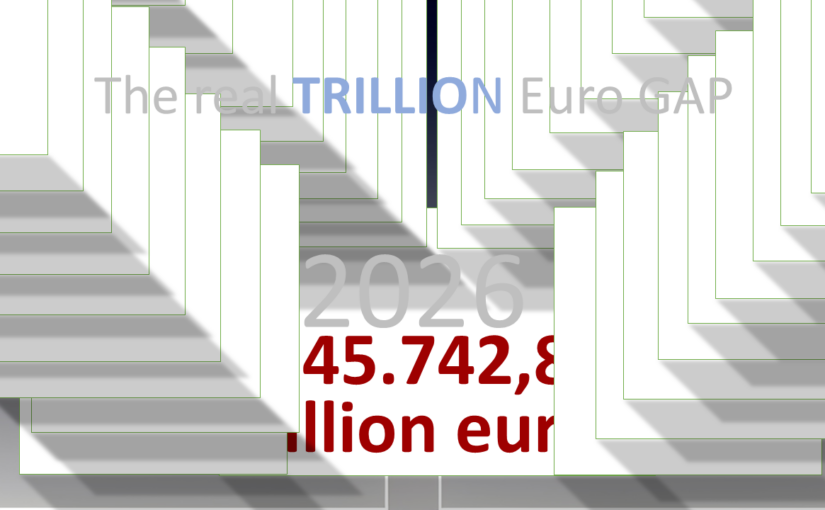
Total GAP 2026: €45,742.8 trillion
Trusted WEB 4.0 technologies such as Finder (1999), getmysense (2002), GISAD (2003), EU-D-S (2004), and WAN anonymity (2007) could have served as the foundation for a European digital alternative.
The EU now has the chance to correct these mistakes – before it is too late.
Notes on Understanding the GAP and the Trusted WEB 4.0 Bonus
For the years 2003 to 2026, I estimated an annual loss of trust in the economy and in digitalization. For the years 2027 to 2030, I awarded a Trusted WEB 4.0 Bonus. You can find the individual years via the search https://finders.de/?s=, followed by the year – for example https://finders.de/?s=2003 for the year 2003.
Even though the GISAD studies (available from 2027 onward) draw on the most valid figures possible for the forecasts of the future, this is not possible with precision, neither for the GAP nor for the Trusted WEB 4.0 Bonus. 9/11 caused the United States to focus on the surveillance industry, thereby influencing global societal development for decades after 2001. Nobody dares to quantify the damage caused by a single year of detrimental development for the emergence of a digital society over the next 100 years. However, an estimate is necessary so that politicians understand the impact their lack of a proactive digital strategy will have on the economy and society in the future.
Even 10 percent of the European GDP is not far-fetched in my view, since the economy too depends primarily on psychological factors. If, from 2027 onward, the EU-D-S succeeds in counteracting the feeling shared by many people that autocracies may perhaps do it even better, with the hope of an emerging genuine digital society, then the impact expressed in a Trusted WEB 4.0 Bonus for the next 100 years can hardly be valued highly enough. From 2031 onward, I refrained from further estimates because the variables had become too numerous even for an estimate.
Sources:
- IEA: Electricity 2024 – Global electricity demand and supply trends
- Finder Technology (1999): Patent ES2374881T3
- getmysense (2002): Loss of Trust Harming the Economy
- GISAD (2003): Preparation of a Kill Switch by Some Players
- EU-D-S (2004): Have EU Applicants Squandered Their Digital Sovereignty?
- WAN Anonymity (2007): Participant Protection Instead of Data Protection
- IEA: Data Centres and Data Transmission Networks – Energy Consumption Trends